|
Getting your Trinity Audio player ready...
|
For years, the unfinished towers of Oceanwide Plaza have loomed over Figueroa Street as a monument to interrupted ambition. Across from Crypto.com Arena and steps from L.A. Live, the three skeletal high-rises were meant to symbolize the next phase of downtown Los Angeles’ rise. Instead, since construction halted in 2019, they have embodied stagnation — a $1.2-billion dream frozen mid-build.
Now, a buyer has emerged.
A partnership led by Riverside County-based KPC Development Co. has agreed to purchase the long-troubled property for $470 million, pending bankruptcy court approval expected by April 9. The firm is headed by Kali P. Chaudhuri, a developer with projects in California and India, who says his intention is straightforward: finish what was started.
If approved, the deal would mark one of the most closely watched real estate turnarounds in downtown Los Angeles in recent memory.
A Project That Stalled in Public View
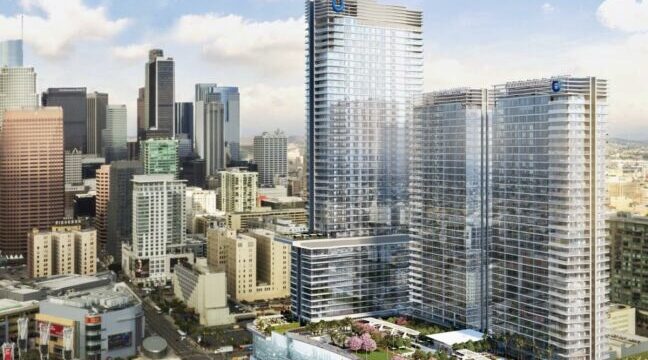
The complex began with global ambition. In 2014, Beijing-based Oceanwide Holdings acquired a prominent parking lot across from the arena and launched plans for a transformative mixed-use development. The proposal called for luxury condominiums, high-end apartments, a five-star hotel, retail shops, restaurants, and a massive LED screen wrapping the base — an electronic marquee designed to give Figueroa Street a Times Square-style glow.
The three towers rose quickly, reshaping the skyline. Then financing unraveled.
By 2019, construction stopped. Contractors walked off site. Cranes froze in place. What remained were buildings roughly 60% complete, wrapped in exposed concrete and glass, sitting idle in one of the city’s most active corridors.
An April 2024 appraisal by Colliers, filed in bankruptcy proceedings, estimated the project’s as-is value at nearly $434 million. The same report projected roughly $865 million to complete construction. Other industry estimates have placed completion costs closer to $1 billion.
The numbers underscore the scale of the gamble facing any buyer.
Graffiti, Base Jumpers and a Cultural Flashpoint
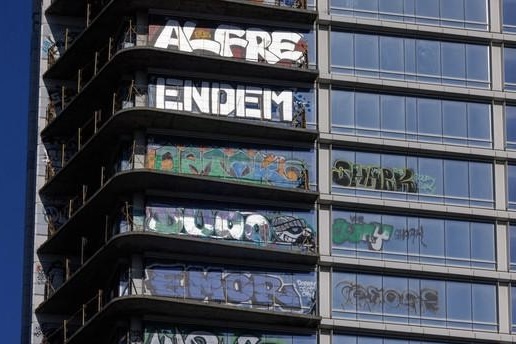
In early 2024, the stalled towers took on a new identity. Taggers scaled the unfinished structures, transforming entire façades into sprawling murals of stylized lettering and layered street art. What began as scattered markings soon became a full-building takeover — a vertical gallery visible across downtown.
Base jumpers parachuted from the upper floors. A performance artist documented himself balancing on a one-inch slackline strung between two of the 40-story towers. Social media amplified the imagery, and the abandoned megaproject became an unlikely cultural landmark.
For some, the graffiti represented blight — evidence of civic disorder in a struggling downtown core. For others, it was an organic, if unauthorized, artistic intervention on a failed monument of global capital.
Either way, Oceanwide Plaza became impossible to ignore.
The New Buyer
The proposed rescue comes from KPC Development Co., led by Chaudhuri. The company develops commercial properties in California and abroad and is currently building a $300-million hotel next to SoFi Stadium in Inglewood, part of Rams owner Stan Kroenke’s larger Hollywood Park redevelopment.
In bankruptcy court filings, KPC partnered with Lendlease — the project’s original contractor — to submit the initial purchase agreement. The $470-million bid establishes a baseline price; if no higher qualified offer emerges before April 9, the court could approve the sale.
Chaudhuri has said that if the transaction closes, several months of due diligence and city approvals would follow before construction resumes. The first visible step, he indicated, would be removing the graffiti. After that, the intention is to complete the complex largely as originally envisioned: housing, hotel rooms, retail space and restaurants.
The first construction phase would also include installing the massive LED screen wrapping 11th, Figueroa and 12th streets — a long-delayed feature central to the project’s identity.
Chaudhuri also plans to rename the development, distancing it from its original sponsor.
Symbolism Beyond Concrete
Large projects stall from time to time. Financing shifts. Markets cool. Developers overextend. But rarely does a development falter so publicly, in such a visible and symbolic location.
The site sits in South Park, at the center of downtown’s sports and entertainment district. Year-round events at Crypto.com Arena, conventions nearby, and the steady flow of visitors to L.A. Live make the location prime by nearly any real estate metric.
That contrast — premium location, frozen construction — amplified the project’s symbolism. Oceanwide Plaza became shorthand for downtown’s uneven recovery after the pandemic, for foreign capital retreating, and for the fragility of large-scale urban ambition.
A completed project would alter that narrative. Hundreds of housing units, hotel rooms and retail storefronts would add foot traffic and economic activity. The LED display would reshape the nighttime streetscape. Construction jobs would return to a long-idled site.
Still, significant hurdles remain: financing, construction costs, regulatory approvals and market demand for luxury residential and hotel space in a changing downtown environment.
For now, Oceanwide Plaza stands as it has for years — unfinished but no longer entirely in limbo. With bankruptcy court approval potentially days away, the graffiti-covered towers may soon transition from urban curiosity back to active construction site.
Whether they ultimately become the “jewel of downtown” their new buyer envisions will depend not just on capital and cranes, but on whether the city around them is ready for another chapter in its skyline story.