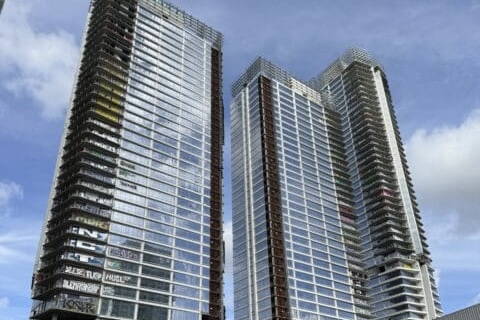
The saga of Oceanwide Plaza continues as the city struggles to reconcile with Downtown’s most controversial public monument. What began as a billion-dollar dream of luxury living in the South Park Social District has turned into one of California’s longest stalled projects, a 49-story canvas for the city’s graffiti community now colloquially known as the “Graffiti Towers,” and a literal yo-yo of anticipation as the town wonders, what will happen next?
How Did We Get To This?
The project’s history dates back to 2014 when Beijing-based Oceanwide Holdings acquired the 4.6-acre parking lot across from what was then the Staples Center. Construction officially broke ground in 2015 with plans for a massive three-tower complex designed by CallisonRTKL.
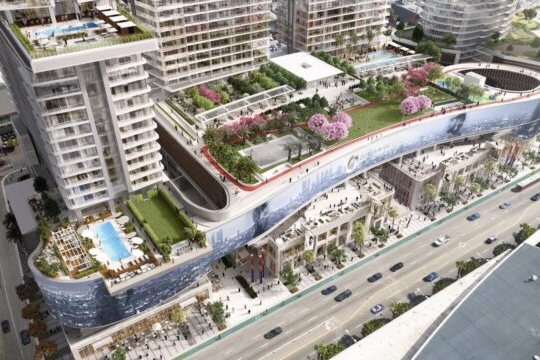
Photos courtesy of Oceanwide Towers
The vision was grand: a 49-story tower housing a five-star Park Hyatt hotel and 164 serviced residences, flanked by two 40-story towers containing over 500 luxury condominiums. At the base, a two-acre amenity deck and a 166,000-square-foot retail galleria were intended to create a vibrant streetscape, highlighted by a block-long LED ribbon that would serve as the West Coast’s answer to Times Square.
For several years, the project moved forward steadily, but the tides turned in early 2019. Following a crackdown by the Chinese government on outbound capital and a cooling of the global real estate market, Oceanwide Holdings abruptly ran out of funds. Work ceased in January 2019, leaving the structures roughly 60% complete and exposing the developer to a wave of lawsuits.
The Birth of Graffiti Towers
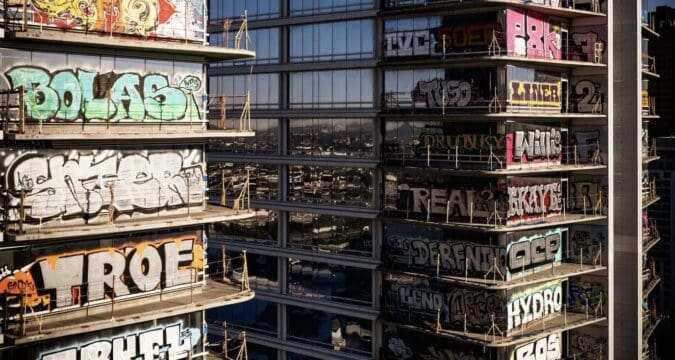
For years, the site sat in a state of suspended animation, a skeletal presence in the skyline that served as a reminder of the volatility of international investment. This transition from a construction site to a cultural landmark peaked in early 2024 when a worldwide coordinated effort brought groups of taggers to spray-paint each window from top to bottom. By February 2024, the act had gone viral, leading to subsequent surges that continue to invite even more street artists.
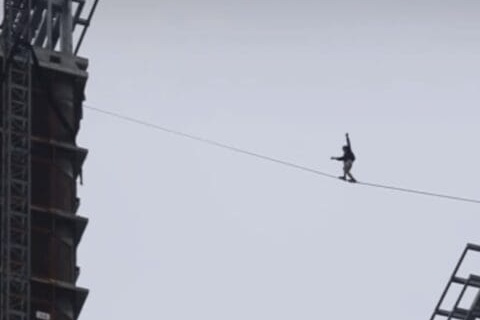
The spectacle was further amplified by base jumpers and tightrope walkers who filmed themselves at the summit, forcing the LAPD to spend upwards of 3,000 officer hours and over $150,000 in just a few weeks to secure the perimeter. While city officials initially threatened to bill the owners $4 million for graffiti removal, the paint remained, and the site is now a makeshift tourist attraction.
KPC and the Latest in Foiled Plans
The path toward a resolution began when Lendlease, the project’s original general contractor, led a petition for an involuntary Chapter 11 bankruptcy. After years of litigation, a significant milestone was reached in February 2026 when KPC Development Co. and Lendlease filed a $470 million purchase agreement.
The proposed deal was seen as the most viable route to finishing the project, with the new owners expressing a commitment to stripping the graffiti and completing the original vision in time for the 2028 Olympic Games.
However, the delay in the finalization of the sale is a byproduct of financial skepticism, regulatory pushback, and the sudden emergence of a rival bidder. While the city and the public were hopeful for an April resolution, the bankruptcy court has extended the timeline to May 2026 to address these critical obstacles.
The primary source of resistance comes from Los Angeles County and federal officials who are scrutinizing the $470 million bid. Their concerns are twofold: first, there are millions of dollars in unpaid property taxes and municipal fees that have accumulated since 2019. Creditors are demanding clarity on exactly how and when these debts will be settled.
Show Us the Money!
Second, there is significant skepticism regarding KPC’s “proof of funds.” While the purchase price is $470 million, industry experts estimate that it will cost an additional $800 million to $1 billion to actually finish the towers. Federal officials are reportedly questioning whether the current buyers have secured the necessary construction loans to see the project through to completion.
Complicating the matter further is a late-stage offer led by the firm CityView. Unlike the KPC bid, which is a “credit bid” involving a complex restructuring of existing debt, the CityView proposal is reportedly being framed as a cleaner, more immediate financial exit for the bankruptcy estate.
Do We Really Need More Time?
This has forced the court to pause and evaluate which offer provides the greatest recovery for the various subcontractors and lenders who have been waiting years for payment. The City of Los Angeles has also requested more time to review the deal terms to ensure that any new owner is legally and financially bound to specific timelines for graffiti removal and site security.
Yes, the situation has shifted significantly just in the last few days. On March 30, 2026, the federal bankruptcy court officially granted a motion to push the confirmation hearing—which was originally set for April 9—back to May 19, 2026, at 10:00 a.m.
This five-week delay is primarily to allow the court and involved parties to sort through several legal and financial sticking points. One major factor is the need for more time to process ballots and responses from creditors. For example, a recent stipulation was filed to extend the deadline for Woodbridge Glass, Inc. to submit their ballot and respond to the liquidation plan.
The extension also gives the court more breathing room to scrutinize the $470 million KPC Development and Lendlease bid. As noted in the recent filings, the “mounting resistance” isn’t just about the purchase price; it’s about ensuring the transition of ownership is clean. This includes resolving the complex web of mechanics’ liens—which total roughly $168 million—and addressing the deep concerns from the city and federal creditors regarding the buyer’s ability to actually fund the $1 billion required to finish construction.
While Mayor Karen Bass and Downtown stakeholders are pushing for an “expeditious close” to get the towers ready for the 2028 Olympics, the court is prioritizing a resolution that settles the “value-destructive litigation” once and for all. For now, the May 19 date is the new finish line to see if this deal actually crosses the threshold or if the “Graffiti Towers” will face even further delays.
This mounting resistance suggests that the court is no longer viewing the KPC bid as a guaranteed conclusion, but rather as one of two competing paths forward for the most famous unfinished project in the West.