The Greater Los Angeles Black Leaders Collective (GLABLC) represents a massive shift in regional power that extends far beyond the borders of any single neighborhood. This is a Los Angeles County-wide coalition, led by executives and organizations whose influence is felt from the halls of Sacramento to the global stage.
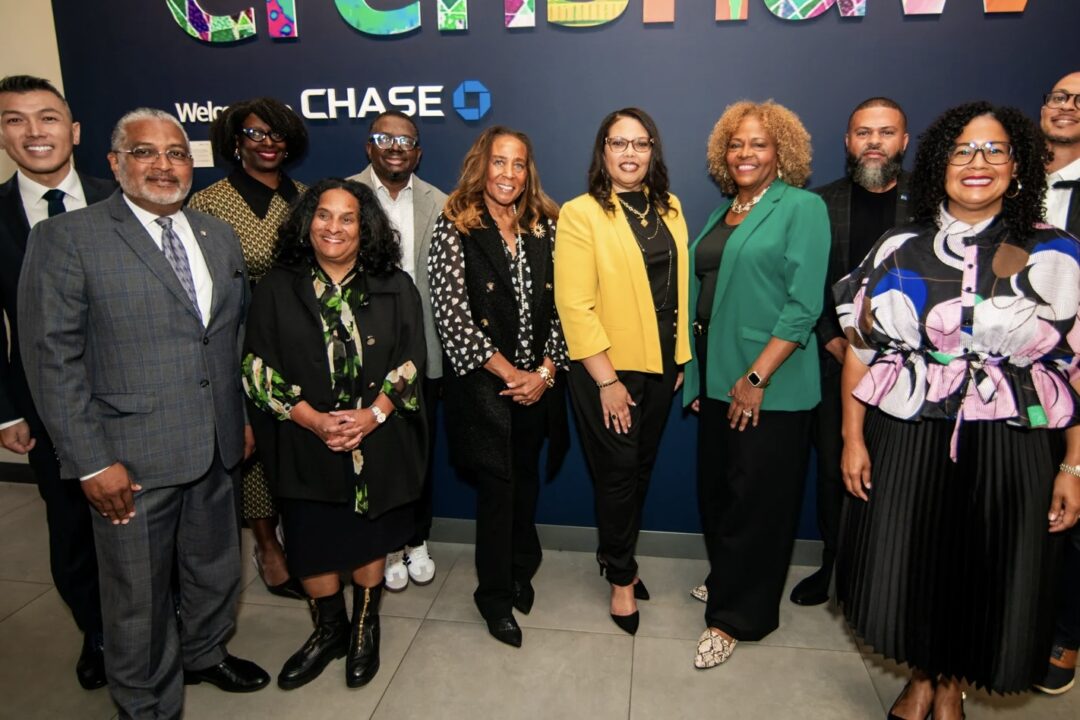
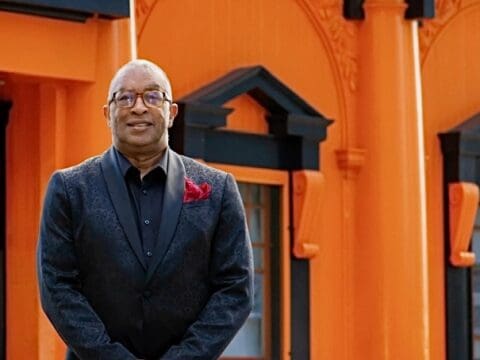
Photo courtesy Jordan Renville/Joren Photography
While its leadership—including Sarah R. Harris of the Black Business Association, Cynthia Mitchell-Heard of the Los Angeles Urban League, and Angela Gibson-Shaw of the African American Chamber of Commerce—resides and operates across the vast landscape of Southern California, their unified presence creates a “super-coalition” equipped to drive economic equity, community recovery, and systemic change when it comes to coordinate funding, advocate for transformative policy, and build infrastructure to empower historically disinvested Black communities.
The most urgent mission of the Collective is to change a system where Black developers and entrepreneurs are often “at the table” but rarely allowed to “design the menu.” For decades, the advocacy for Black-owned businesses in the district was fragmented, with individual organizations fighting separate battles at City Hall.
The GLABLC fundamentally shifts this dynamic by pooling data, political influence, and financial resources into a single, coordinated force.
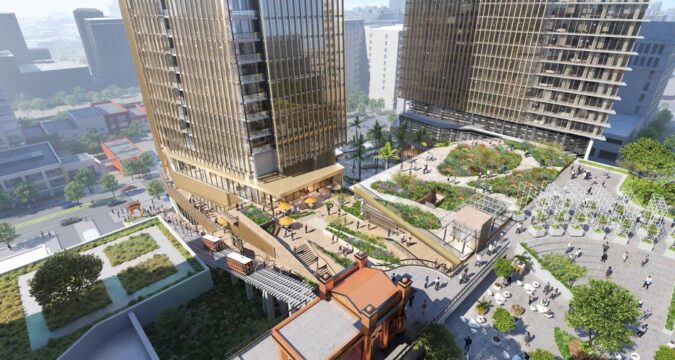
View from Angels Terrace – photo: Handel Architects
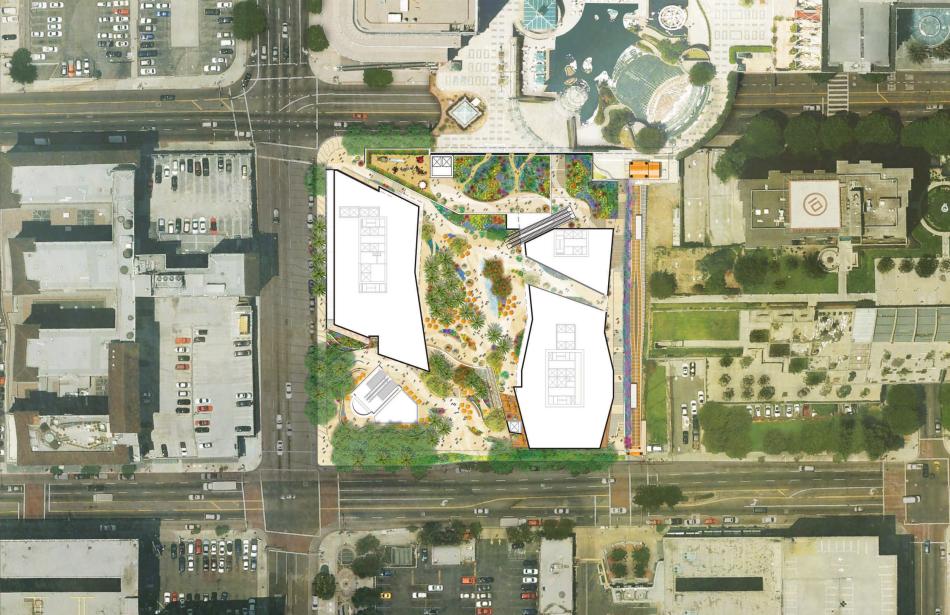
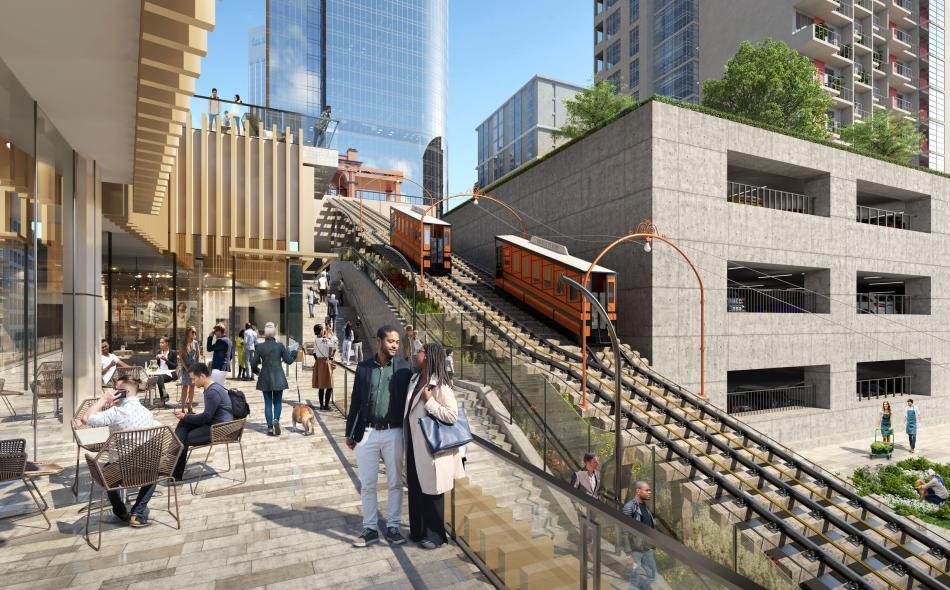
The clearest and most painful example of why this Collective is necessary can be found at the site of Angels Landing on Bunker Hill. Once heralded as the crown jewel of Black-led real estate in the Western United States, the $1.6 billion twin-tower project was set to redefine the skyline at 4th and Hill Streets.
Led by prominent developers Victor MacFarlane and Don Peebles, the project promised to be the tallest skyscraper ever built by a Black-owned firm, featuring luxury hotels, condos, and a charter school. Most importantly for the district, the developers committed to a gold standard of 30% minority and women-owned business contracting—a deal that would have injected over $480 million directly into the pockets of local minority firms and workers.
However, in early 2024, the City of Los Angeles abruptly terminated its exclusive negotiating agreement with the developers, effectively killing the project. The city cited a technical “transfer of interest” as the reason for the cancellation, arguing that the developers violated their contract when they restructured their partnership.
MacFarlane and Peebles immediately fired back with a $20 million lawsuit, alleging wrongful termination and political interference. By late 2025, the site was declared “surplus land” by the state, opening it up to affordable housing developers and leaving the original vision in a state of legal paralysis.
The stall of Angels Landing isn’t just a loss of a building; it is a loss of nearly half a billion dollars in wealth-building opportunities for the Black community.
View from Angels Terrace – photo: Handel Architects
If the GLABLC had been established then, the Angels Landing outcome could have been fundamentally different.
Under the old system, MacFarlane and Peebles were forced to fight City Hall in a legal vacuum.
With the Collective’s Policy Change and Practice Transformation pillar, this technicality would have been met with a unified civic front.
The GLABLC would have intervened at the policy level to ensure that an administrative “transfer of interest” was not used as a loophole to strip a Black-led project of its entitlements. The Collective’s high-level diplomats could have stood between the developers and the city’s red tape, holding officials accountable to the 30% contracting goals that were the heartbeat of the project’s community benefit agreement.
The GLABLC’s strategy for the future of black developments is built upon four specific pillars that address the root causes of these failures.
The first, Economic Mobility, focuses on creating direct ownership pathways for residents and business owners. For a Black developer in 2026, this means having access to a “procurement pipeline” that is transparent and protected from political whims.
The second pillar, Direct Relief, provides a financial safety net for businesses that are often the first to suffer when major projects like Angels Landing are delayed. By stabilizing these small businesses, the Collective ensures that the neighborhood’s economic fabric remains intact even when the skyline’s progress is slow.
Beyond real estate, the Collective is reimagining the stability of Black-led nonprofits through its Community Impact pillar.
Many of the organizations that serve the district’s most vulnerable residents are currently facing “philanthropic cutbacks” and shifting federal priorities. The GLABLC addresses this by providing data-driven storytelling and a unified fundraising apparatus to ensure these anchors of the community can scale their operations rather than just surviving on “crumbs.”
By treating the nonprofit ecosystem as a vital part of the district’s “social infrastructure,” the Collective ensures that as the real estate market grows, the community’s social support systems grow with it.
For Black entrepreneurs, the Collective offers a path from being “renters” to being “owners.” Through their strategic alliances, the GLABLC is advocating for city-backed acquisition funds that allow small business owners to buy their commercial spaces.
In a district where property values are skyrocketing due to the 2026 World Cup and the 2028 Olympics, ownership is the only true protection against displacement. The Collective’s presence ensures that the billions of dollars in infrastructure spending planned for the next three years don’t just pass through Downtown, but stay in the hands of the people who have been amongst the cultural heartbeat for decades.
For more information on their initiatives and how to support their mission of intergenerational wealth, visit their official digital hub. https://greaterlablc.org