|
Getting your Trinity Audio player ready...
|
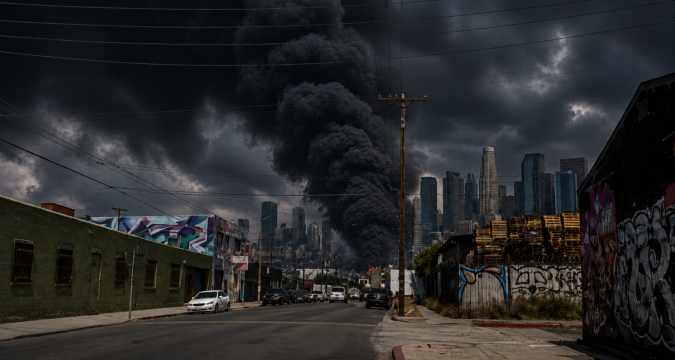
When a massive fire tore through the Lineage cold storage warehouse in June, it quickly became one of the most difficult industrial fires Los Angeles has faced in years. Firefighters battled the blaze for more than a week as sections of the nearly 500,000-square-foot building became engulfed in flames with thick black smoke drifting across the region.
Inside the warehouse were an estimated 80 to 85 million pounds of frozen food, including meat, poultry, seafood, and other perishables. Once the refrigeration systems failed, the neighborhood was left facing an entirely different disaster, one that continues long after the last fire engine left the scene.
Today, the aftermath has become a daily reality for thousands of Boyle Heights residents, many of whom say they are still living with conditions they never imagined.
The most noticeable reminder is the overwhelming odor. As millions of pounds of food decompose inside the damaged warehouse, a powerful smell has spread throughout Boyle Heights and neighboring communities.
To make matters worse, as heavy trucks haul away waste, rodents and other pests continue to thrive within the decomposing food
Residents describe it as the odor of a decomposing body, saying it has seeped into homes, vehicles and businesses. Some report headaches, nausea, eye irritation, loss of appetite and difficulty spending time outdoors. While the smell itself is not necessarily considered toxic at the levels found outdoors, it has become one of the community’s biggest complaints and a constant reminder that the cleanup is far from complete.
Is the air safe to breathe?
During the early days of the fire, Mayor Karen Bass stated that the air was “not dangerous,” a comment that quickly drew criticism from residents who were already experiencing sore throats, headaches and irritated eyes while watching thick smoke drift across their neighborhoods.
Later, Bass clarified that the air was generally considered safe for people in good health. However, children, seniors, pregnant women, and those with asthma or other respiratory conditions were advised to limit their exposure and follow public health guidance. For many Boyle Heights residents, the clarification came too late.
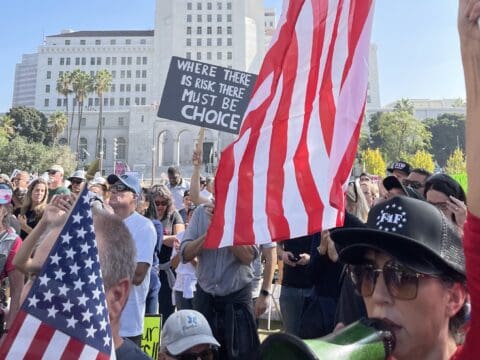
They argued that the changing message created unnecessary confusion at a time when the public was looking for clear, consistent information about the risks facing their families, and they couldn’t wait to express those concerns in the form of “boos” at a recent town hall with Mayor Karen Bass, CD 14 Councilmember Ysabel Jurado and Greg Lehmkuhl, President and CEO of Lineage.
Still, health officials continue encouraging residents to monitor air quality updates and seek medical attention if respiratory symptoms persist.
Bottom line, the residents of Boyle Heights want the thousands of tons of spoiled food, contaminated debris and damaged building materials safely removed before the property can be redeveloped.
Bad for Business
The financial toll on local business has been significant. Nearby businesses have reported fewer customers, road closures have disrupted normal activity, and note taxpayers are expected to shoulder millions of dollars in emergency response costs before reimbursement efforts are complete.
Perhaps the greatest damage has been to public trust.
Many in Boyle Heights are questioning why a warehouse storing tens of millions of pounds of frozen food operated so close to homes, schools and businesses. Others criticized what they viewed as slow communication, conflicting information and a cleanup process that has not moved quickly enough.
In response, the City of Los Angeles, Los Angeles County and the State of California have launched several recovery efforts. Mayor Karen Bass issued emergency executive orders designed to accelerate cleanup, coordinate agencies and hold Lineage financially accountable for eligible recovery costs. A Boyle Heights Community Resource Center was established to provide residents with information, health services and assistance.
Thousands of HEPA air purifiers and N95 masks have been distributed, while mobile health clinics have offered free medical evaluations for people experiencing smoke-or odor-related symptoms. Through partnerships with nonprofit organizations, some residents have received temporary housing assistance, food support and financial aid, while small businesses have become eligible for recovery grants and counseling. Air quality monitoring has also been expanded, and environmental agencies continue testing the area as cleanup progresses.
There will be lawsuits
Despite these efforts, many residents believe much more could be done. Community members continue calling for faster removal of the decomposing food, greater transparency from Lineage, long-term health monitoring, stronger oversight of industrial facilities located near residential neighborhoods and assurances that a disaster of this magnitude will never happen again.
Adding another layer to the aftermath is a growing wave of litigation. In the weeks following the fire, residents, business owners and workers began filing lawsuits against Lineage and other parties connected to the warehouse, alleging negligence, public nuisance, property damage, lost business income and health impacts stemming from the prolonged fire, smoke, odor, lost business income, loss of customers, respiratory irritation, and other physical symptoms.
While the courts will ultimately determine liability, the lawsuits signal that the fire’s consequences may continue long after the cleanup is complete. In addition to private lawsuits, many residents have called for Lineage to reimburse taxpayers for the millions of dollars spent on emergency response and recovery efforts.
The fire may be over, but for Boyle Heights, the recovery—and the questions surrounding it—are only just beginning.