|
Getting your Trinity Audio player ready...
|
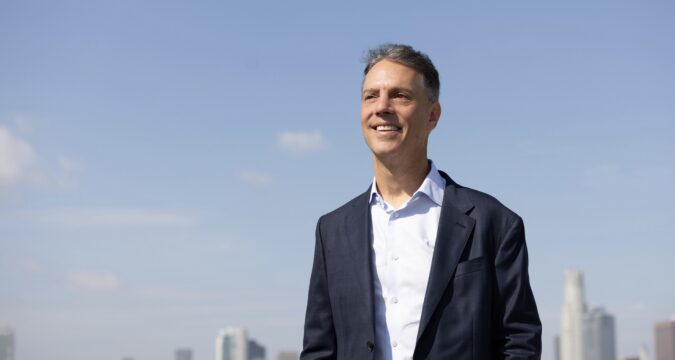
Mayoral candidate Adam Miller says Los Angeles needs a builder—not a politician.
Los Angeles mayoral candidate Adam Miller is positioning himself as an outsider with a results-driven background in business and nonprofit leadership. With a platform focused on homelessness, housing affordability, and public safety, Miller argues that the city needs operational discipline and accountability to address its most pressing challenges. In this interview with DTLA Weekly, he outlines his priorities, leadership style, and vision for fixing Los Angeles.
DTLA Weekly: For readers who may not know you yet—what’s your elevator pitch as a mayoral candidate, and why should Los Angeles be paying attention?
Adam Miller: My elevator pitch is simple: Los Angeles is broken. We need a builder to fix it. I’ve spent 35 years as an executive—running corporations and nonprofits—and I’ve delivered real results across multiple industries. I can bring that same operational experience, strategic thinking, and financial discipline to the city and fix this place.
DTW: If elected, what are the top three things on your agenda? How quickly would residents feel those changes?
Adam Miller: The top three things I want to accomplish are reducing street homelessness by 60%, lowering average rents by 10% by increasing housing supply, and doubling police patrols across the city. These are big goals, but with urgency and proper execution, residents will begin to see meaningful changes quickly.

Photos Courtesy Adam Miller
DTW: What is the very first thing you would do in office?
Adam Miller: The first thing I’m going to do is introduce a new app for residents called Fix LA, designed to drive transparency and accountability across the city. Residents will be able to report issues like broken streetlights, damaged sidewalks, potholes, trash, or homeless encampments and track how those issues are addressed.
The app will also provide insight into city operations—permit applications, construction timelines, project budgets, how long permits have been pending, and how public funds are being spent. It’s about giving Angelenos real visibility into how their city is functioning.
DTW: You’ve said you’re not a politician by nature. How does that differentiate you from your competitors?
Adam Miller: Two of my opponents are career politicians. One has been mayor for four years, and the other has overseen housing and homelessness on City Council—areas that have struggled in recent years.
As an outsider, I come in without political obligations or alliances. I don’t owe favors to special interests, which allows me to focus entirely on what’s best for all Angelenos.
DTW: You’ve worked extensively in the private sector. What does that mean to you, and what was your role within it?
Adam Miller: I’m an entrepreneur. I started a company in my apartment with the goal of using the internet to improve global access to education.
Over 20 years, I built that company from the ground up—10 years as a private company CEO and 10 years as a public company CEO. We grew to 3,000 employees across 25 countries, delivering over 2 billion classes to more than 100 million people in 182 countries.
That’s what I mean by private sector experience—I know how to build, scale, and execute.
DTW: You’ve mentioned “running LA like a business.” What does that actually look like, and how does it benefit everyday residents—not just the bottom line?
Adam Miller: You can’t run government exactly like a business, but you can apply the same core principles: set a clear vision, build a strong team, align that team around goals, operate with excellence, measure results, and hold people accountable.
That’s how I’ve led organizations my entire career, and those principles translate into better outcomes for residents—more efficiency, improved services, and real, measurable results.
DTW: Yeah, I’m afraid LA is turning into Detroit.
Adam Miller: Wow, yeah, I say that all the time. Detroit is a generational issue that won’t be solved in five or ten years.
DTW: That leads me to my next question—21% of voters in California are Gen Z. What does being mayor mean for younger voters in LA?
Adam Miller: Look, I think it depends on the neighborhood, but for parts of the city, workforce development is super important. For Gen Zers, a lot of the jobs people have been trained for are not the jobs that are going to be around five years from now. So we need to make sure people are getting trained for the next set of jobs.
Affordability is also a huge issue. It’s just so expensive to rent an apartment in the city, and the only way to solve that problem is by having more apartments. Rent control doesn’t solve the problem—it just passes on the problem. We need more building to solve that.
Quality of life matters too. It’s hard to have a great quality of life with such a large homelessness crisis affecting the city.
DTW: Is there anything you’re currently working on or initiatives you want readers to know about? Where can they follow or support your campaign?
Adam Miller: You can follow and support the campaign at votemiller.com.
Right now, I’m leading two major initiatives. On the homelessness side, through my nonprofit Better Angels, we’ve built one of the most effective homelessness prevention programs in LA County, helping keep thousands of Angelenos housed who were on the brink of eviction.
On workforce development, I launched the 1,000 Interns Initiative, which has already placed over 2000 young people from South and East LA into tech jobs they wouldn’t have otherwise accessed. This year, we’re adding another 500 internships.
These are the kinds of results I’ve delivered—and what I plan to bring to the city.
For more on Adam Miller’s campaign, including policy proposals and upcoming initiatives, visit votemiller.com. He also maintains an active presence on social media, where he engages directly with voters and shares updates from across Los Angeles.