The odds of having a song stream over 100,000 times on Spotify is 4.3%. Jump that number to a million, and success rates turn to decimal percentages. The average TikTok account will garner around 1,000–5,000 views within its active lifespan, and most accounts that do see virality quickly fade. So how did musician Geller manage to not only beat the odds on Spotify but stick around after his online success?
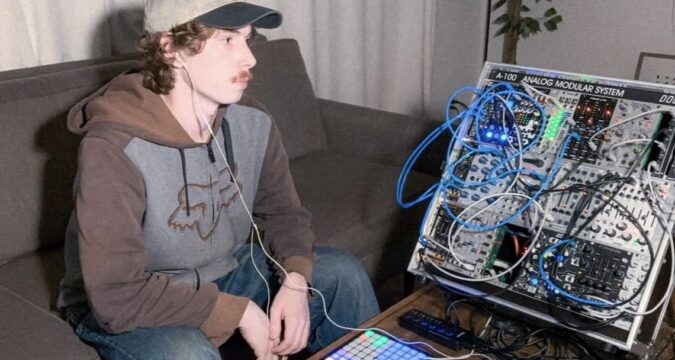
It’s the fourth show Geller’s put on this year, hidden in an artist loft on the outskirts of DTLA’s Chinatown. The power has gone out twice—something has surged or a fuse has blown—and no one is sure what the cause is. It might be coming from the hallway, a now liminally grey waiting space once covered in musicians’ projection art, or maybe from the main room, where Geller stands listening to instructions from the stage next to a six-foot-tall analog synth rig that looks like it was taken out of MoCA. The crowd is silent, the room is hot, and anticipation is building as everyone stands and waits for the world of Geller to turn back on. Minutes go by, whispers begin to fill the air, and then the room reignites into color. The main projection is up and running, and Geller jumps back into one of the many cinematic electronic tracks off Parallel Play, “Uniformity.”
Listening to Parallel Play, Geller’s downtown show begins to feel almost emblematic of the record, which ebbs and flows in contemplative ambiance that then turns into textured, melodic bursts of life. Tracks like “If I Fall” and “Fragments” might be some of the best examples, delivering a sense of catharsis that is still a rarity within the experimental electronic world. Geller’s fresh and distinct sound is on full display throughout the EP, whose experimentation and genre-bending speak to a larger artistic mentality that is ultimately the source of his staying power.
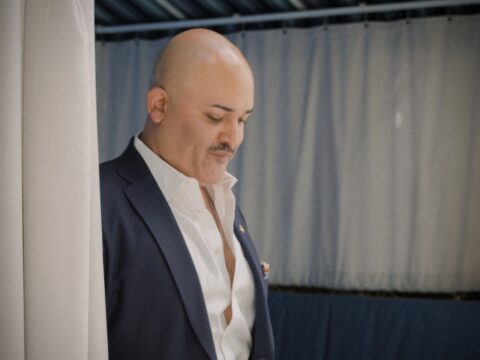
Austin Geller, better known by his stage name, is a musician, visual artist, public event organizer, and film and TV composer. His EP Parallel Play is a nod to the phenomenon seen within child development where peers play independently while alongside each other. Much of Geller’s body of work can be described in the same way. At the age of 25, his passion for film scores has already seen him compose for 10 movies. His free-to-attend live electronic music series, Public Sounds, which he organizes, has become a favorite among Angelenos, and his digital projection art could give any private college art major a run for their money.
This week, DTLA Weekly sat down with the artist to discuss his new EP and the string of projects that have helped him defy the odds.
DTW: Let’s start at the beginning. How did your journey as an electronic artist begin?
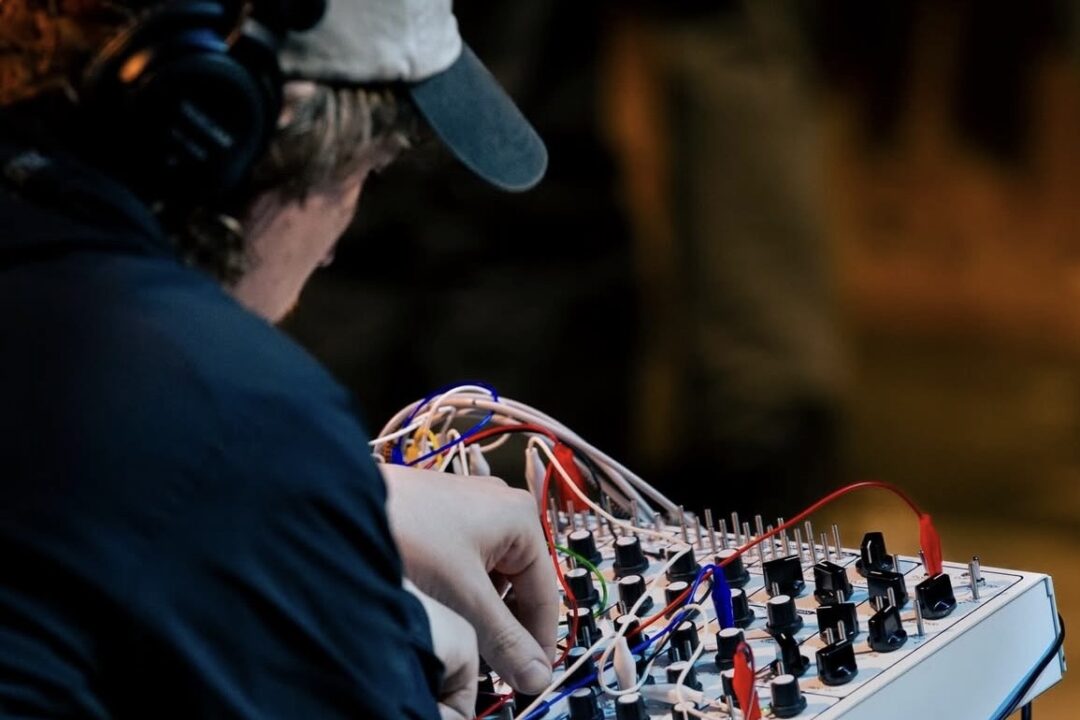
It’s interesting because growing up, I wasn’t really a fan of—or at least what I thought was—electronic music. When I was in high school, though, a friend introduced me to some of the early stuff from Flume and Kaytranada, and that opened my view. I didn’t know there was that side of electronic music. Then I ended up messing around with Ableton, trying to teach myself how to produce.
DTW: What was a moment where making music began to really click for you?
I would say during the pandemic. I was trying to figure out what I wanted to do as a musician. That was probably when I really started to get more into the kind of niche, avant-garde space of electronic music.
DTW: Can you point to where things began to change for you and your career?
Last year, I played my first true headline show. That show was before my last EP, Couch Fever, came out, so the whole setlist was me testing out new music. There was one song—it was kind of just an interlude moment. I had no real intention to put it out because I wasn’t sure how it would be received. Someone who was there got a video of a moment in that song where this synth did something a little unpredictable, but it ended up sounding really good, and I posted that clip. The video went super viral. That was a defining moment for me in a lot of ways. One being, “Okay, well now a lot of people are seeing my stuff.” But I think more importantly, there is an audience for anything, and I shouldn’t really feel restricted to these conventional song structures of electronic music.
Geller on the aftermath of the video:
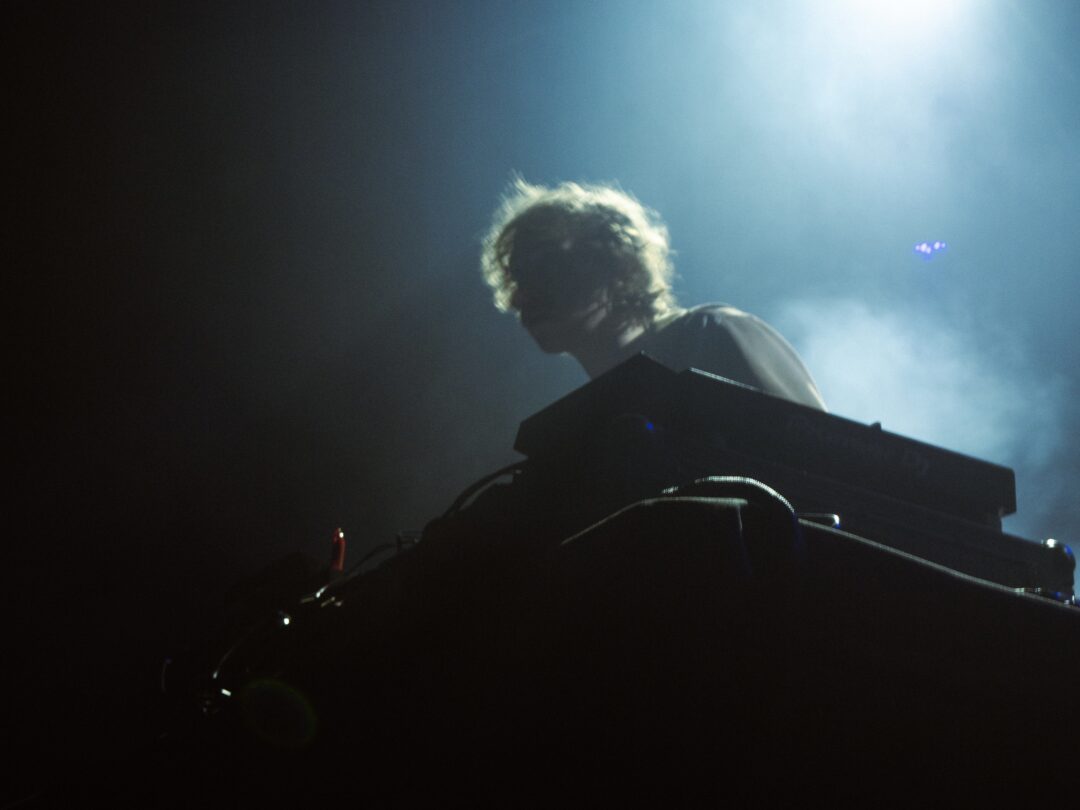
You know, I think that was kind of when I was like, “Yeah, I’m just going to double down on this approach to songwriting,” and I ended up putting that song out. That song and moment definitely was a catapulting moment for my career. Most of the things that have happened for me since then were probably the result of that moment.
A momentum Geller is still building on, with recent co-signs by juggernauts Shallou and Chet Porter – with whom he went on tour in 2024 – and projects like Public Sounds.
DTW: Switching gears a bit, as you’ve gone on in your career, what artists have influenced you the most?
Aphex Twin, Brian Eno, Boards of Canada. I think a big one for sure would be Oneohtrix Point Never. When I started listening to those artists, for one, I really liked how involved they are across multiple mediums—scoring for film, making music for a fashion show—and that really spoke to me.
On the note of multimedia musicians, the Parallel Play show went beyond the usual concert experience.
DTW: Could you expand on your thought process behind the event?
Yeah, absolutely. Personally, I feel like a lot of my music is pulling from a lot of different inspirations. On the surface, it doesn’t seem like they would blend together well, so I like the idea of the visual language reinforcing what’s happening with the music. You’ve got these different mediums and these different kinds of looks all happening at once, but altogether it forms a bigger picture.
DTW: Tell us more about the sonic world of Parallel Play.
I’m very big into harsh contrasts. A very overdriven, aggressive synth with very airy and soft strings over it. I wanted it to feel like a dreamy space—something you could move around to, but also totally zone out in.
DTW: Texture plays a big part in your work, especially on this project. Can you speak to its importance?
Almost all of the ideas that have turned into songs—or even didn’t—start with texture because you can create that atmosphere. For me personally, the rest of it kind of just falls into place. It’s almost like method acting. If you can get into a certain headspace, the rest of the song coming together feels very natural.
DTW: What are some defining moments on the record?
“Uniformity.” For one, it doesn’t have a conventional song structure at all, but I think that’s me leaning into that realization I had come to. Probably the biggest reason is that it was the first idea for a song that I came up with after putting out my prior project. I was on a plane going on tour with Chet Porter after the release of my last project. In the green room before the show, I added a very raw, early demo to the setlist. I had no lyrics yet—I may have completely freestyled the first show. I remember thinking, “That sounded really cool. I should record that,” and I eventually did. Everything else kind of came after that.
DTW: What feelings or themes are you trying to communicate in the EP?
I think it’s a reaction to the modern world and information overload—the collapse of so much of what we were raised on. It’s all happening at once, and you’re kind of just expected to take it on the chin.
As of late, Geller’s experimental outdoor electronic series has also picked up steam. The free-to-attend series features ambient tracks played in scenic spots throughout the city.
DTW: Public Sounds has been another major project of yours. How did it come to be?
I had put out Couch Fever and went on tour. To be totally honest, a lot of that stuff just happened way faster than I thought it would. I was like, “It’d be really cool if I took my synthesizers out to the park and brought a picnic.” It’s less of a show where I’m the performer. I wanted a stripped-back thing where I could improvise and experiment. Public Sounds was my way of doing that.
DTW: What have been some challenges?
The biggest thing is being mindful of the communities and neighborhoods we’re doing these things in. Making sure the people who show up are being respectful has been the biggest stress factor.
DTW: What has it been like planning Public Sounds?
Geller: I really wanted each event to provide a unique experience, so finding a new location every time is equally cool, if not cooler. We’ve found some great spots—and when I say “we,” I mean I just kind of drive around. I grew up in LA, so I’ll hike around and find a spot. At that point, it’s just about adjusting parameters on the fly.
Geller has carved out a space that goes far beyond virality or trends. His longevity lies not only in his musical prowess but also in his film work and forward-thinking projects like Public Sounds and his new series, Testing. This multidimensional approach leans more toward building an artistic world rather than a persona, and, like any good artist, breaks form in a space desperately in need of reexamination. In short, Geller has created a playbook that any musician looking to outlast the digital feeds should look at.
Geller’s music can be found on all streaming platforms. For updates on his concert series, follow him on Instagram @GellerMusic.