
 Hanny Playa
|
Getting your Trinity Audio player ready...
|
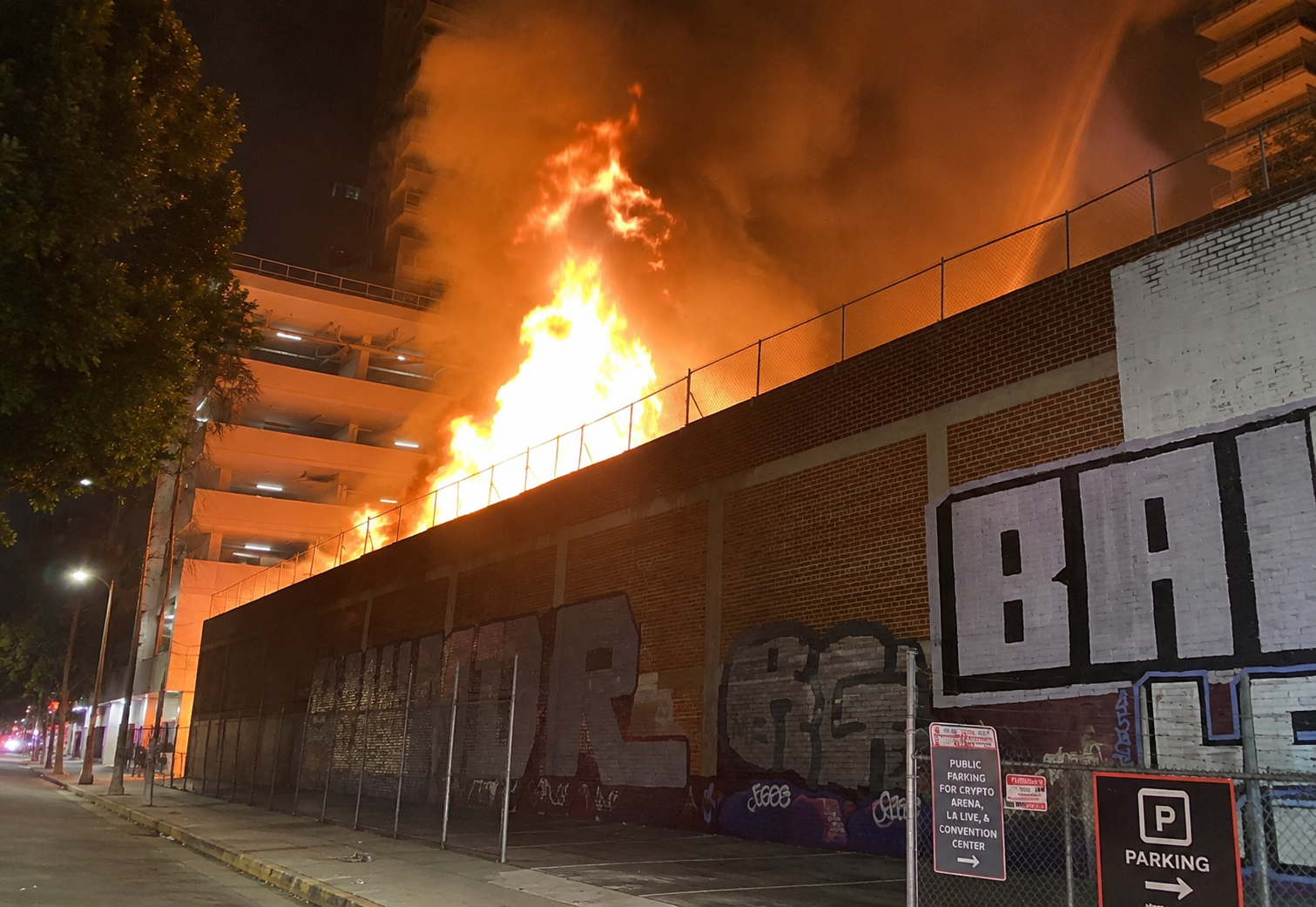
Following five reported fires in 18 months, Social District President Nolan Marshall III is urging Los Angeles officials to consider stronger enforcement measures, including demolition of qualifying vacant structures.
The Social District, formerly known as the South Park Business Improvement District, is calling on the City of Los Angeles to address a series of vacant and fire-damaged buildings along Hope Street between 12th Street and Pico Boulevard, citing repeated fires, unauthorized entry, and concerns about public safety.
In a letter addressed to the Los Angeles Board of Building and Safety Commissioners, Social District President and CEO Nolan A. Marshall III requested that the Los Angeles Department of Building and Safety (LADBS) exercise its authority under existing municipal regulations to address properties the district considers hazardous.
According to the letter, at least five fires have occurred on the block over the past 18 months. Marshall also reports that vacant structures have repeatedly been entered without authorization, despite more than a year of efforts to secure properties on the east side of the street.
“The conditions on this block have persisted for too long, consumed too many public resources, and created too great a threat to public safety to justify another temporary response,” Marshall wrote.
The district maintains that the recurring incidents have required responses from the Los Angeles Police Department, Los Angeles Fire Department, BID personnel, and other city resources.
Repeated Fires Raise Questions About Property Maintenance
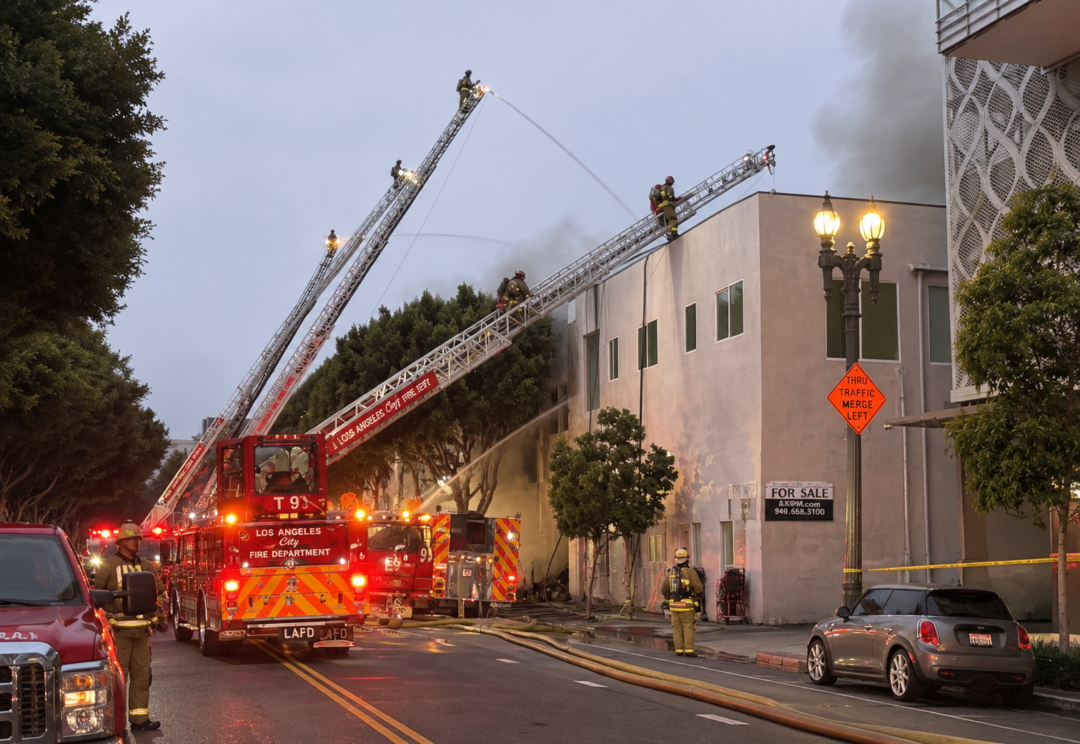
Photos — AI-assisted photo illustration.
The conditions described in the letter raise questions about the responsibilities of property owners and the city’s ability to enforce building and safety regulations when structures remain vacant for extended periods.
Marshall argues that measures such as boarding windows, installing fencing, and hiring private security may reduce unauthorized access but do not necessarily resolve underlying structural deterioration or neighborhood blight.
“A secured burned-out building is still a burned-out building. A fenced vacant property is still a dead frontage,” Marshall stated.
The letter does not identify the individual property owners or provide a breakdown of the five reported fires, including their causes, dates, or resulting damage.
Those details would be relevant to determining whether particular structures qualify for additional enforcement measures.
Vacant buildings can present different levels of risk depending on their structural condition, accessibility, maintenance, and compliance with city requirements. Some may be repaired or secured, while others may require more extensive intervention.
Social District Cites Municipal Code
The district is specifically requesting action under Los Angeles Municipal Code Section 91.8904.2, which addresses certain vacant buildings that may be deemed public nuisances because of fire damage, repeated unauthorized use, or other qualifying conditions.
Marshall is asking LADBS to evaluate the affected structures, establish enforceable deadlines for abatement, and pursue demolition where statutory requirements are satisfied.
Under the city’s regulatory framework, determining whether demolition is appropriate requires consideration of the condition of each property and the applicable legal procedures.
The district’s request does not itself establish that the buildings meet the legal criteria for demolition.
The letter also does not indicate whether LADBS has already issued orders to comply, nuisance determinations, or demolition notices for the specific properties.
Johnny Wactor Killing Referenced in Public Safety Appeal
Marshall’s letter also references the May 25, 2024, killing of actor Johnny Wactor, who was fatally shot in the 1200 block of Hope Street after leaving work and encountering individuals attempting to steal a catalytic converter from his vehicle.
The shooting occurred along the same stretch of Hope Street identified in the district’s complaint.
Marshall acknowledges that the vacant buildings should not be blamed for Wactor’s death. Instead, he cites the incident in discussing the importance of lighting, pedestrian activity, and maintaining active streets.
The connection between vacant properties and criminal activity is complex, and the letter does not present evidence linking the condition of the buildings to Wactor’s killing.
Nevertheless, the district argues that long stretches of inactive street frontage deserve attention as part of broader neighborhood safety planning.
A Key Downtown Corridor Near Major Destinations
The affected properties are located near several significant Downtown destinations, including the Pico Metro Station, L.A. LIVE, the Los Angeles Convention Center, California Hospital, and surrounding residential developments.
The area is also expected to experience activity associated with the 2028 Olympic and Paralympic Games.
With major events approaching, city agencies and neighborhood organizations have been examining transportation, pedestrian access, lighting, public safety, and infrastructure conditions across Downtown Los Angeles.
Marshall’s letter places the Hope Street properties within that broader discussion, suggesting that the condition of vacant buildings should be considered alongside other neighborhood improvements.
The proximity to major destinations also raises practical questions about how pedestrians navigate blocks containing vacant structures, particularly during evening hours.
Demolition Versus Future Development
The district points to a property at 12th and Olive Streets as an example of an abandoned structure that was demolished and replaced with a surface parking lot pending redevelopment.
While acknowledging that parking lots are not the preferred long-term use for Downtown property, Marshall presents the cleared site as an alternative to maintaining a damaged vacant building.
The letter also states that properties on the east side of the affected Hope Street block are entitled for future residential development.
Such entitlements can allow owners to pursue construction, although they do not necessarily establish when work will begin.
“Entitlement is not abatement,” Marshall wrote.
The distinction is central to the district’s request. Marshall is asking city officials to address current conditions independently of whatever development may eventually occur.
At the same time, demolition can involve significant costs, permitting requirements, and legal considerations. Depending on the condition of a structure, rehabilitation or other corrective measures may also be available.
The appropriate remedy would depend on property-specific inspections, ownership responsibilities, and applicable municipal requirements.
Who Is Responsible for the Costs?
Another issue raised in the letter is the use of public resources to respond to repeated incidents at privately owned properties.
Fire and police responses, inspections, code enforcement, and security-related activity can require substantial personnel time and municipal resources.
Marshall argues that property owners should be held responsible for addressing conditions on their properties rather than allowing recurring problems to require continued public intervention.
The letter does not quantify the costs incurred by the city or district in responding to the reported incidents.
Whether those expenses can be recovered from property owners would depend on the circumstances and the city’s applicable enforcement and cost-recovery provisions.
What Happens Next?
The Social District is requesting that the Board of Building and Safety Commissioners and LADBS establish a clear process for addressing the affected properties, including deadlines for corrective action and demolition where legally warranted.
The letter calls for a safe interim condition until future redevelopment occurs.
It remains unclear from the correspondence whether the city has made formal nuisance findings concerning the properties, what enforcement proceedings may already be underway, or whether the owners have submitted plans to repair, secure, or demolish the structures.
The property owners’ positions and the city’s response were not included in the material provided.
For now, the district’s letter places the reported conditions on Hope Street before city officials and asks them to determine whether existing enforcement measures are sufficient.
The outcome could provide a closer look at how Los Angeles balances private property rights, development timelines, code enforcement, and public safety concerns in neighborhoods undergoing continued redevelopment.
As Marshall concluded in his appeal, “The City has the authority to act. The documented conditions warrant action.”
Whether the city agrees with that assessment, and what action it ultimately takes, remains to be seen.



 Keri Freeman

