|
Getting your Trinity Audio player ready...
|
Speed cameras, Metro surveillance, e-bike crackdowns, street takeover busts, DUI checkpoints and parking enforcement. Welcome to Los Angeles, where the freedom of the open road comes with terms and conditions.
Congratulations, Los Angeles. The city that gave America lowriders, cruising boulevards, convertible Cadillacs, freeway culture and the Hollywood car chase has officially entered a new era. One in which just about every move a motorist makes can be monitored, photographed, cited, or used as evidence.
Remember when driving was supposed to represent freedom? The open road, the wind in your hair, music blasting through the speakers, and nowhere in particular to go?
Well, forget all that.
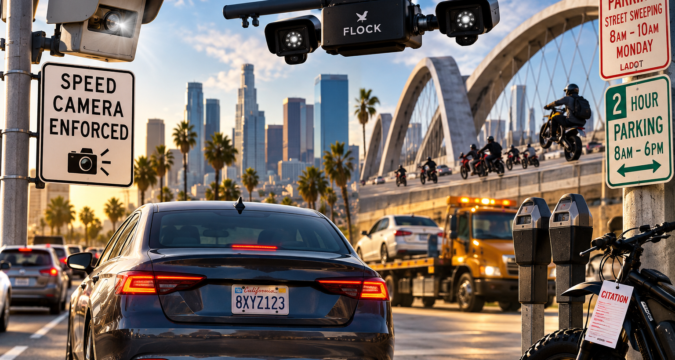
Beginning October 26, 2026, Los Angeles will activate its first wave of approximately 20 automated speed cameras, with 125 locations expected to be operational by the end of the year. The Los Angeles Department of Transportation says the cameras will target motorists traveling at least 11 miles per hour above the posted speed limit.
The cameras photograph rear license plates, record violations, and send the information for review before notices are mailed to vehicle owners. Each location begins with a 60-day warning period, and qualifying first violations receive additional warning protections under the program.
Once fines apply, speeding 11 to 15 mph above the limit costs $50, 16 to 25 mph costs $100, and 26 mph or more costs $200. Reach 100 mph, and the penalty rises to $500.
Fortunately, these are civil penalties, meaning no DMV points and no direct insurance consequences from the camera citation itself. How thoughtful.
The five-year pilot program was authorized under California Assembly Bill 645 and is intended to reduce dangerous speeding, injuries, and traffic deaths. Officials say speeding contributed to approximately one in five fatal crashes in Los Angeles in 2024.
Nobody wants more people dying on the roads. But with cameras, license plate readers, bus surveillance, drones, and enforcement operations expanding across Southern California, the question is becoming difficult to ignore: How much of the freedom associated with driving is left?
Smile, You’re on Metro Camera
As if stationary speed cameras weren’t enough, Los Angeles Metro has found a way to put cameras on wheels.
Metro buses operating on Lines 70, 212, 720, 910, and 950 are equipped with systems that photograph vehicles illegally parked in bus lanes and at bus stops. They collect license plate images, photographs, short videos, and location information for review by city enforcement personnel.
In Los Angeles, an illegal bus-lane parking citation can cost $293.
So the next time a bus pulls up behind a car, the driver might want to remember that the passengers aren’t the only ones looking out the window.
Metro says the technology improves transit reliability and accessibility, especially for passengers with disabilities. Fair enough. But the buses have effectively become traveling parking enforcement units.
The system isn’t supposed to issue tickets merely because a vehicle appears on camera. A suspected violation must be documented and reviewed.
Still, it is one more reminder that motorists no longer need to see a parking enforcement officer to end up with a citation.
Buckle Up, Buttercup
California drivers and passengers are required to wear seatbelts. A first adult seatbelt violation carries a $20 base fine, while subsequent violations carry a $50 base fine. Mandatory assessments can make the actual amount substantially higher.
Drivers can also be cited when passengers under 16 aren’t properly restrained, while child safety seat violations carry even greater penalties.
A first child-restraint violation has a $100 base fine, increasing to $250 for subsequent violations, before assessments.
Seatbelts save lives, of course. But motorists might be surprised to discover just how expensive that little click can become when they forget it.
And don’t forget the cellphone. Holding and operating a phone while driving can bring another citation. The first violation carries a $20 base fine, increasing to $50 for subsequent offenses, plus assessments. Repeat violations within 36 months can also add a DMV point.
No texting, scrolling, watching videos, or holding the phone to check directions while driving.
Apparently, the only screen drivers are supposed to stare at is the one telling them how much gas they have left.
Drinking and Driving: The Ultimate Financial Disaster
Driving under the influence is an entirely different category of trouble. Getting arrested for driving under the influence in California, the punishment can make a $500 camera ticket look like pocket change.
California generally prohibits driving with a blood alcohol concentration of 0.08% or higher for most adult motorists, although drivers can be arrested for impairment even below that level. Commercial drivers and motorists under 21 face stricter limits. Police also conduct DUI checkpoints and saturation patrols, particularly around holidays and major events, looking for drivers impaired by alcohol, marijuana, prescription medications, and other drugs.
A first DUI conviction can carry a base fine of $390 to $1,000, additional court assessments, probation, and up to six months in jail, although 30 days in jail is not automatically mandatory for first-time offenders. And unlike an ordinary camera ticket, a DUI is a criminal offense that can leave drivers with a criminal record.
Then comes the real financial hangover. Drivers generally must complete a state-approved DUI education and counseling program lasting three months, or nine months in certain cases involving higher blood alcohol levels. Their licenses can be suspended for six months or longer following conviction, although restricted driving privileges may be available.
Getting back behind the wheel can require an SR-22 certificate proving financial responsibility, DMV reinstatement fees, and possibly an ignition interlock device (IID), a special breathalyzer connected to the vehicle that prevents the engine from starting when alcohol is detected. Depending on the offense and circumstances, drivers may be required to use the device for months or even years.
Repeat offenders face tougher penalties, longer DUI education programs, mandatory ignition interlock requirements in many cases, longer license suspensions, and potentially substantial jail time. A third DUI within 10 years generally carries a minimum of 30 days in jail when probation is granted.
Add towing, vehicle impound fees, attorney expenses, DUI classes, court costs, equipment installation and maintenance, and skyrocketing insurance premiums, and the California Highway Patrol has estimated the overall cost of a DUI at approximately $13,500. Actual expenses can vary considerably, and some cases cost much more.
And don’t expect the consequences to disappear once the fines are paid. A DUI generally remains on a California driver’s record for 10 years for purposes of determining repeat-offender penalties, while the criminal conviction can remain on the person’s criminal record beyond that period.
Of course, that’s before considering the devastating consequences of injuring or killing someone, which can result in far more serious criminal charges, prison sentences, and financial liability.
Congratulations! That one night out may cost more than the car itself. And unlike the city’s newest speed cameras, there’s no 60-day warning period before the consequences begin.
This is one category where nobody should be looking for a loophole.
Street Takeovers? LAPD Has a Surprise.
Remember when hundreds of drivers could gather at an intersection, spin doughnuts, burn rubber, block traffic, and disappear before police arrived?
Those days are getting considerably more complicated.
In September 2026, LAPD launched a coordinated crackdown known as Operation Street Sweeper, targeting illegal street takeovers across Los Angeles.
During one major operation in Harbor Gateway, more than 150 officers responded to a gathering involving approximately 700 people. Police used intelligence gathering and drone technology to identify planned takeover locations and coordinate their response.
The final reported results were staggering: 69 arrests and 200 impounded vehicles.
Officers used containment tactics to prevent vehicles from simply scattering when police arrived.
For years, takeover participants have treated major intersections like personal racetracks, with spectators gathering dangerously close to vehicles performing burnouts and doughnuts.
Now, police are increasingly using the same technology associated with modern surveillance to identify gatherings and organize large-scale enforcement.
Drivers participating in illegal takeovers can face reckless-driving charges, exhibition-of-speed allegations, vehicle impoundment, towing fees, and possible criminal penalties. Spectators may also face citations or other consequences depending on their conduct and applicable laws.
Vehicle impoundment can be particularly expensive, with towing and daily storage fees accumulating while the owner attempts to recover the car. Certain violations can result in lengthy impound periods.
Imagine arriving at a takeover expecting to watch someone destroy a set of tires, only to discover the police have arranged a surprise parking lot from which nobody is driving home.
The crackdown also raises questions about how broadly police use containment tactics and how they distinguish participants from people who happen to be nearby.
Still, one thing is clear: Los Angeles police are no longer relying solely on chasing individual cars after an intersection has been taken over.
They’re planning to get there first, surround the activity, and make it considerably harder to leave.
E-Bikes: Even Two Wheels Aren’t Safe From the Rulebook
Thinking about ditching the car and buying an electric bicycle?
Not so fast.
California has stepped up its attention to electric bicycles, particularly high-powered models that look like bicycles but perform more like motorcycles.
Legal e-bikes generally fall into three classifications. Class 1 pedal-assist bicycles provide assistance up to 20 mph. Class 2 bicycles can use a throttle up to 20 mph. Class 3 pedal-assist bicycles can provide assistance up to 28 mph.
But an electric vehicle capable of exceeding the legal limits may no longer qualify as an e-bike.
In April 2026, California Attorney General Rob Bonta issued a consumer warning about high-powered electric bicycles and modifications that can turn them into vehicles subject to motorcycle or moped laws.
California also established a separate category for off-highway electric motorcycles in 2026, with restrictions on their use on public streets.
That means certain popular high-powered electric bikes cannot legally be treated like ordinary bicycles simply because they have two wheels and handlebars.
And for anyone wondering just how serious LAPD has become about enforcing those rules, the department provided a spectacular demonstration on Downtown Los Angeles’ Sixth Street Bridge.
On September 13, 2026, LAPD’s Street Racing Task Force descended on the iconic bridge after receiving intelligence about a planned gathering of minibike and e-bike riders. More than 70 people, many of them teenagers, were reportedly performing wheelies, spinning doughnuts, riding against traffic, and blocking the roadway.
Rather than chasing individual riders through Downtown Los Angeles, police coordinated an operation to surround the group. More than a dozen police vehicles blocked access to the bridge, trapping the riders between officers with nowhere to go.
The result? 78 misdemeanor citations, 78 impounded minibikes and pocket bikes, and two additional vehicles seized for allegedly assisting the takeover.
The bikes were subject to impoundment for at least 48 hours, while two pickup trucks reportedly used by adults accompanying the riders were impounded for 30 days.
Musical Chairs Auto Edition: Even When the City Is Wrong, You Pay
Los Angeles motorists have already spent decades mastering the city’s elaborate parking restrictions.
Street sweeping, expired meters, red curbs, yellow loading zones, white passenger loading zones, green time-limited spaces, blocked driveways, fire hydrants, disabled parking, oversized vehicles, temporary no-parking signs, and special-event restrictions all present opportunities for citations.
A driver can park legally at 8:59 a.m. and discover that the street becomes restricted at 9:00.
The street sweeper may never actually clean the pavement, but the ticket can still arrive.
And as it turns out, that isn’t just a joke.
In July 2026, an investigation by L.A. Material uncovered more than 12,500 street-sweeping citations issued over five years on days when no street sweeping was scheduled, representing nearly $1 million in questionable fines.
The controversy dates back to 2021, when Los Angeles reduced residential street sweeping from weekly to biweekly service. Unfortunately, thousands of street signs continued displaying weekly parking restrictions, leaving motorists to decipher which weeks actually counted.
Apparently, the city could figure out how to issue the tickets every week, but communicating which weeks the streets were being cleaned proved considerably more complicated.
The investigation found that many questionable citations were concentrated in lower-income neighborhoods, where residents often depend on limited street parking and a $73 street-sweeping ticket can represent a significant financial burden.
LADOT initially maintained that erroneous citations were proactively canceled and that drivers who had already paid were contacted about reimbursement.
But a follow-up investigation published in September found that thousands of questionable tickets apparently remained unresolved. Some motorists who contested their citations were reportedly told they still owed the money.
In other words, drivers could receive a ticket on a day when no street sweeping was scheduled, challenge the citation, and still be told to pay.
Following the revelations, LADOT announced an audit of street-sweeping citations and promised to reimburse motorists whose paid tickets were determined to have been issued in error.
The controversy even reached Los Angeles City Hall. On September 30, the City Council approved a series of recommendations calling for reports on restoring weekly street sweeping, improving public notifications, reviewing improperly issued citations, and developing a process to refund affected motorists within 15 days.
The proposals also included exploring automated enforcement technology mounted on street sweepers.
Yes, after a controversy involving thousands of tickets issued when street sweepers weren’t supposed to be operating, City Hall was already discussing the possibility of putting cameras on the street sweepers themselves.
Because apparently, the solution to a parking ticket controversy might just be more cameras.
To be clear, a street-sweeping ticket isn’t automatically invalid simply because a sweeper doesn’t pass a particular parked car. The controversy concerns citations issued on days when sweeping was not scheduled or had been canceled, contrary to the city’s enforcement policy.
Motorists who believe they received an improper citation can contest it through LADOT’s Parking Violations Bureau. The department has also acknowledged that some previously paid citations may qualify for reimbursement following its review.
Meanwhile, ordinary parking violations remain a daily financial hazard. Some fines are relatively modest. Others, particularly violations involving disabled parking spaces or obstructing transit access, can reach hundreds of dollars.
And if a driver doesn’t pay on time, late penalties can make the situation worse.
For residents who depend on street parking, the daily challenge is practically a competitive sport.
The only difference is that in the Los Angeles Parking Ticket Olympics, everybody pays to participate, and even when the referee gets the rules wrong, getting the money back can become another competition entirely.
Red Lights, Stop Signs, and Other Expensive Adventures
California’s traffic laws offer plenty of additional ways to receive a citation without ever encountering an automated camera.
Running red lights, rolling through stop signs, making illegal U-turns, failing to yield to pedestrians, driving too closely, changing lanes unsafely, ignoring turn restrictions, and failing to signal can all lead to tickets.
Some violations carry DMV points, potentially affecting insurance costs.
Speeding tickets issued by police also differ from LADOT’s new civil camera citations. Traditional moving violations can carry court assessments, DMV points, and other consequences.
Then there’s reckless driving, street racing, exhibition of speed, driving on a suspended license, and hit-and-run offenses, all of which can carry more serious penalties.
California drivers must also maintain required insurance, current registration, functioning lights, proper license plates, and legally compliant vehicle equipment.
Excessively tinted front windows, defective headlights, missing plates, and other equipment problems may lead to citations, some of which are correctable.
For a city where people practically live in their cars, the number of rules is impressive.
Flock Safety: Big Brother Is Reading Your License Plate
Beyond ordinary traffic enforcement, Los Angeles drivers have another set of electronic eyes to worry about: Automated License Plate Readers (ALPRs), including systems manufactured by Flock Safety.
These cameras record license plates, dates, times, locations, and identifying vehicle characteristics such as make, model, and color. Flock’s technology allows authorized law enforcement agencies to search collected information across participating camera networks, subject to access restrictions and agency policies.
Police use ALPR systems to locate stolen vehicles and identify cars connected to criminal investigations. Unlike LADOT’s speed cameras or Metro’s bus-lane enforcement systems, Flock cameras generally aren’t designed to automatically issue routine traffic tickets.
But privacy advocates question how long vehicle information is stored, who can access it, whether agencies share data across jurisdictions, and how easily these networks could reconstruct someone’s movements.
Here’s the catch: Drivers don’t have to commit a crime or violate a traffic law to have their vehicles recorded. Simply passing a camera can be enough.
Flock Safety isn’t the only company providing this technology. LAPD and other Southern California law enforcement agencies have used various ALPR systems, each operating under its own policies and agreements.
Between speed cameras, Metro’s bus-mounted surveillance, police license plate readers, and technology deployed during street takeover operations, motorists face an expanding network of electronic monitoring.
Apparently, Big Brother doesn’t need to ride shotgun anymore. He’s already waiting at the next intersection.
Don’t Forget the Rest of the Rulebook
And for motorists who somehow avoid the cameras, checkpoints, parking enforcement officers, and police operations, there are still plenty of other ways to get into trouble.
Illegal car modifications, excessively loud exhaust systems, unlawful street racing, speeding through construction zones, unsafe loads, unsecured cargo, failing to yield to emergency vehicles, blocking intersections, ignoring railroad crossings, improper motorcycle lane splitting, driving in restricted lanes, and violating pedestrian right-of-way laws can all result in enforcement.
Motorcycle riders face helmet requirements. Commercial drivers face additional licensing and safety regulations. Rideshare drivers must comply with applicable operating rules. Truck drivers have weight, routing, and equipment restrictions.
Even drivers who are simply sitting in their vehicles can find themselves violating parking, idling, or stopping restrictions depending on the location.
So buckle up, put down the cellphone, watch the speedometer, renew the registration, check the insurance, read the parking signs, avoid the bus lane, leave the street takeovers alone, and make sure that expensive electric bicycle is actually legal. Or else.