|
Getting your Trinity Audio player ready...
|
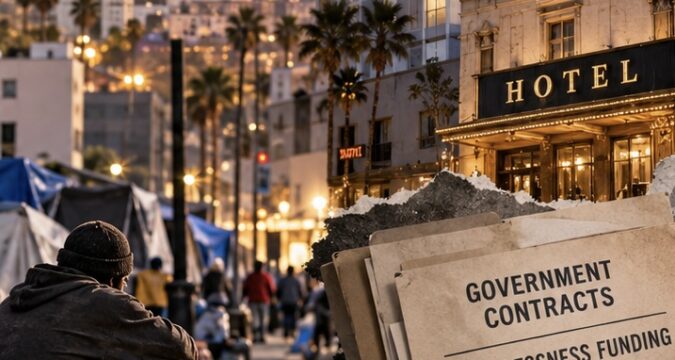
Downtown Los Angeles — On Skid Row, thousands of people struggle without permanent housing while millions of dollars flow through government agencies, nonprofit organizations, developers, and hotel owners entrusted with helping them.
Just blocks away, a supportive housing tower costs more than $600,000 per apartment. A former luxury hotel received tens of millions of dollars to shelter homeless residents, despite its owner’s separate connection to one of Los Angeles’ largest City Hall corruption scandals. Federal investigators have accused nonprofit executives of diverting homelessness funding into nightclubs, luxury purchases, and personal investments.
The money comes from everywhere: federal grants, city and county budgets, voter-approved bonds, real estate taxes, and state housing programs.
The promise was to move people off the streets, provide safe shelter, and create permanent housing. But following the money reveals government contracts, questionable expenditures, financial investigations, lawsuits, and criminal prosecutions.
The question is no longer simply how much Los Angeles spends on homelessness. It is who receives the money, what they were supposed to provide, what they actually delivered, and what happened when they failed.
The L.A. Grand Hotel: More Than $54 Million and a City Hall Corruption Connection
In Downtown Los Angeles, the L.A. Grand Hotel became one of the largest temporary housing facilities operating under Project Roomkey, a pandemic-era program created to move vulnerable homeless residents indoors.
The program relied on federal emergency funding and state and local resources. Its purpose was to provide temporary shelter, protect residents from COVID-19, and help connect them with more stable housing.
The L.A. Grand was owned by interests associated with Chinese billionaire Wei Huang and Shenzhen New World Group, which purchased the property in 2010.
The ownership connection was significant because Shenzhen New World had already become involved in a federal corruption investigation surrounding former Los Angeles City Councilmember José Huizar.
Federal prosecutors established that the company provided more than $1 million in benefits to Huizar in an effort to secure favorable treatment for a proposed 77-story redevelopment of the hotel property.
Shenzhen New World was convicted of bribery and fraud and sentenced to pay a $4 million criminal fine. Huizar received a 13-year federal prison sentence for his broader corruption offenses.
Those convictions involved the proposed redevelopment, not the hotel’s later homelessness shelter contract. No court finding established that the Project Roomkey payments themselves were bribes or fraudulent.
Nevertheless, the hotel arrangement generated another controversy.
The Academy of Media Arts, a private school operating in the building, and ROME Nightclub, another tenant, sued over the continued use of the hotel as a homeless shelter.
The school alleged that conditions associated with the shelter interfered with student safety and its ability to operate. The nightclub alleged that the shelter’s continued presence prevented it from opening.
According to the litigation, the city paid the hotel owner more than $54 million while extending the temporary shelter arrangement.
The Academy of Media Arts closed in January 2024, affecting approximately 50 students. The shelter ceased operations in July 2024.
In March 2026, a Los Angeles Superior Court judge dismissed most of the claims against the city, leaving a narrower legal dispute.
The resulting consequences included a shuttered school, litigation, and the closure of the shelter. The separate federal corruption case produced the criminal fine against Shenzhen New World and Huizar’s prison sentence.
What remains unclear is how many residents of the L.A. Grand ultimately obtained permanent housing and whether any payments continued after the shelter closed.
Those figures are essential to understanding what Los Angeles received for its investment.
Weingart Towers: Apartments Costing More Than $600,000 Each
Only a short distance away, the Weingart Towers represent another major public investment in homelessness.
The buildings were developed to provide permanent supportive housing for formerly homeless residents in Skid Row.
The first tower opened in June 2024 with 278 apartments at a reported development cost of approximately $167.7 million, or more than $600,000 per apartment.
The financing included approximately $32 million from Proposition HHH, the $1.2 billion housing bond approved by Los Angeles voters in 2016, along with state housing loans, tax-credit equity, and tax-exempt bonds.
Chelsea Investment Corporation served as a development partner, with reporting identifying approximately $18.3 million in development fees.
The second tower opened in 2025 with 298 apartments at a reported cost of approximately $171 million.
A proposed third tower was estimated at approximately $90 million for 104 apartments, or roughly $866,000 per apartment.
These costs include construction, financing, professional services, and other development expenses. They are not simply the cost of building individual rooms, and development fees are not automatically equivalent to profit.
Unlike failed housing projects, the first two Weingart Towers delivered hundreds of completed apartments.
No criminal finding against Weingart Center or the development partners was established in connection with the reported construction costs.
The controversy concerns the price of delivering permanent supportive housing.
Could Los Angeles house more people by acquiring and converting existing buildings? Could rental assistance provide housing more quickly? Are complicated financing arrangements increasing development costs?
Supporters emphasize that permanent supportive housing provides long-term residences and services for people who may have experienced years of instability.
But at more than $600,000 per apartment, the cost raises questions about how many similar developments Los Angeles can afford.
The result is tangible housing, accompanied by a financial debate over whether the same resources could have helped more people.
LAHSA: The Agency Watching the Money Faces Federal Action
The Los Angeles Homeless Services Authority, commonly called LAHSA, has long been responsible for coordinating homelessness services and overseeing contracts with nonprofit providers.
The agency receives federal, city, and county funding and distributes money for emergency shelter, housing assistance, outreach, and supportive services.
Its responsibility is not simply to spend money but to verify that contractors deliver what they promise.
Yet financial audits and federal investigations exposed weaknesses in LAHSA’s bookkeeping, contract monitoring, conflict-of-interest safeguards, and financial documentation.
In June 2026, the U.S. Department of Housing and Urban Development announced a suspension of LAHSA from federal programs, citing financial management failures and compliance concerns.
HUD reported that the Los Angeles Continuum of Care, led by LAHSA, had received nearly $1 billion in federal homelessness funding over five years.
Federal officials identified problems involving records for nearly 2,300 housing sites, payments associated with vacant hotel rooms, and inadequate conflict-of-interest procedures.
One controversy centered on former LAHSA CEO Va Lecia Adams Kellum and approximately $2.1 million in funding associated with Upward Bound House, a nonprofit employing her husband.
HUD identified conflict-of-interest violations. LAHSA disputed aspects of the federal allegations and maintained that safeguards had been established around the contracting decision.
Kellum resigned in July 2025. Federal officials also considered administrative sanctions, including possible debarment, but a final five-year debarment was not established in the available record.
The suspension threatened approximately $239 million in upcoming federal homelessness assistance and created uncertainty surrounding previously approved funding.
LAHSA challenged HUD’s action in federal court.
In September 2026, a federal appeals court largely upheld an injunction blocking the suspension while litigation continued, preserving the agency’s ability to access funding under the applicable legal conditions.
The result was a serious federal enforcement action, followed by judicial intervention that prevented a complete funding cutoff.
LAHSA was not permanently stripped of all federal funding, and the administrative dispute was not a criminal conviction against its leadership.
Still, the episode raised an uncomfortable question: if the agency responsible for monitoring homelessness contractors is itself accused of failing to account properly for public money, who is watching the agency?
Abundant Blessings: $23 Million for Housing and Meals, Followed by Federal Fraud Charges
In South Los Angeles, Abundant Blessings was supposed to provide housing, supportive services, and nutritious meals to people experiencing homelessness.
Its executive director, Alexander Soofer, obtained approximately $23 million in public homelessness funding, including money administered through LAHSA and Special Service for Groups.
The contracts were intended to support hundreds of residents and provide three healthy meals each day.
Federal investigators, however, reported finding residents receiving ramen noodles, canned beans, and breakfast bars instead of the meals promised.
Prosecutors also alleged that Soofer fabricated invoices, inflated expenses, and diverted public funding toward personal enrichment, including luxury property expenses and unrelated business activities.
In September 2026, the U.S. Department of Justice announced that Soofer had agreed to plead guilty to wire fraud and money laundering.
According to his plea agreement, Soofer admitted obtaining public money through fraud and diverting at least $2 million for his personal benefit and unrelated businesses.
He also agreed to forfeit illegally obtained proceeds.
The plea agreement was a significant development, but an agreement to plead guilty should not be confused with a completed sentencing. The final prison term and restitution obligations depend on subsequent court proceedings.
The case exposed more than alleged financial misconduct. It revealed how residents could receive inadequate services even while an organization collected millions under contracts promising proper care.
The money was supposed to provide shelter and meals. Soofer admitted diverting at least $2 million, while investigators found deficiencies in what residents actually received.
United States Department of Justice
Lakiya Malone: $180,000 in Alleged Kickbacks and Homeless Residents Who Didn’t Exist
The Abundant Blessings investigation also implicated Lakiya Malone, an employee of Special Service for Groups.
Her work involved referring homeless residents to publicly funded housing sites.
According to federal prosecutors, Malone accepted more than $180,000 in bribes and kickbacks from Soofer in exchange for sending referrals to his organization.
The indictment alleges that some referrals involved fictitious participants who never lived at the facilities.
Prosecutors described false welcome letters, forged sign-in sheets, and fabricated eligibility forms used to make the nonexistent participants appear legitimate.
Malone was arrested in September 2026 and charged in a 21-count federal indictment involving fraud, bribery, and conspiracy.
The charges carry substantial possible prison sentences, including up to 20 years for individual wire fraud counts, but those are statutory maximums rather than penalties already imposed.
The intended purpose of the funding was to house real people.
The alleged scheme involved generating payments using records for people who were not receiving the services billed.
The result was a federal prosecution and further questions about how contractors verified that residents actually occupied publicly funded housing.
United States Department of Justice
Home At Last: $118 Million in Public Funding and an Alleged Nightclub Scheme
Home At Last, a Culver City nonprofit founded by Michael Young, received more than $118 million in public homelessness funding beginning in 2019.
More than $75 million reportedly came through LAHSA.
The organization’s purpose was to provide housing and supportive services to homeless residents.
Federal prosecutors allege that Young instead used shell companies, fraudulent invoices, and sham vendors to divert millions of dollars into businesses and personal expenditures unrelated to homelessness.
Investigators identified more than $7.5 million in alleged misappropriated taxpayer funds.
The money allegedly financed the Six Seven Five Lounge, an upscale nightclub in Inglewood, an adjacent bingo hall, commercial properties, luxury vacations, and vintage automobile restorations.
Young was arrested in September 2026 and charged with wire fraud.
The charge carries a maximum possible penalty of 20 years in federal prison, but no conviction or prison sentence was established in the charging announcement.
LAHSA canceled its contracts with Home At Last in June 2026.
That contract cancellation was an immediate organizational consequence, while the criminal case against Young remained subject to the courts.
The public funding was intended to provide housing and assistance. Prosecutors allege that millions instead helped finance a nightclub and private investments.
The case also raised questions about how such large sums could pass through a nonprofit before alleged financial misconduct was detected.
United States Department of Justice
Big Blue Umbrella: A $1.2 Million Grant and Alleged Personal Purchases
Donye Mitchell, also known as Danya Mitchell, served as chief executive of Big Blue Umbrella, a Los Angeles nonprofit seeking to provide housing and mental health assistance.
The organization was awarded more than $1.2 million through Amity Foundation, which administered Los Angeles County-supported funding.
The money was supposed to provide services to vulnerable residents.
Federal prosecutors alleged that Mitchell misrepresented the organization’s staffing, qualifications, and relationships with other service providers to obtain the award.
After approximately $315,000 was disbursed, prosecutors alleged that money was used for personal expenses, including credit card payments, family transfers, and video games.
Amity Foundation terminated the organization’s contract in May 2025, citing concerns over spending representations and failure to meet contractual milestones.
Mitchell was charged with federal wire fraud in September 2026. The initial Justice Department announcement described him as a fugitive.
The charge carries a maximum possible sentence of 20 years, but no imposed sentence was established in that announcement.
The distinction between the $1.2 million awarded and the $315,000 actually disbursed is important. The entire award was not shown to have been stolen.
The documented consequence was contract termination, followed by federal charges over the alleged misuse of funds intended for housing and mental health services.
United States Department of Justice
Carol Adelkoff: $1.6 Million in Compensation, a Santa Monica Apartment, and a BMW in Hawaii
Another controversy involved the 1736 Family Crisis Center, a nonprofit that operates shelters and crisis services for domestic violence survivors and people experiencing housing instability.
The organization receives substantial public funding and operates with an annual budget of approximately $15 million.
Its longtime chief executive, Carol Adelkoff, has led the organization since 1984.
In August and October 2026, the Los Angeles Times reported that Adelkoff received more than $1.6 million in compensation over 2023 and 2024, including approximately $824,000 in accumulated vacation payouts.
The newspaper also found that the organization had paid for a $6,500-per-month luxury apartment in Santa Monica for Adelkoff, whose primary residence is in Hawaii.
The nonprofit additionally leased a BMW for her use in Hawaii and covered related vehicle expenses.
The organization’s attorney said the apartment provided a predictable and secure alternative to hotel accommodations during Adelkoff’s visits to Los Angeles. The vehicle arrangement, the attorney said, was a longstanding part of her compensation package approved by the board.
Former employees had raised concerns about the benefits, and related employment disputes resulted in litigation, including settlements.
The Times reported that no criminal charges had been filed against Adelkoff or the nonprofit, and no pending government investigation was known.
The confirmed consequences were public scrutiny, employee complaints, and litigation—not a criminal conviction or an established government fine.
The distinction matters. High executive compensation and controversial benefits do not automatically establish fraud.
But the case raises questions about how nonprofit boards justify executive compensation while their organizations rely heavily on public funds to serve vulnerable people.
The money was supposed to support crisis services and shelter operations. The organization maintained that executive compensation was part of operating those services, while critics questioned whether the benefits were reasonable.
Los Angeles Times
+1
Project Homekey: Nearly $115 Million, Luxury Purchases, and Housing Properties Facing Foreclosure
Another financial controversy involved Shangri-La Industries, a Downtown Los Angeles-based developer participating in California’s Project Homekey program.
Unlike Project Roomkey, which provided temporary hotel shelter, Project Homekey was designed to convert hotels and other buildings into long-term housing for people experiencing homelessness.
Shangri-La obtained nearly $115 million in public funding for several projects.
The company was led by Andrew Meyers Abdul-Wahab, also known as Andy Meyers, with Cody Holmes serving as chief financial officer.
The money was supposed to purchase, renovate, and operate affordable housing.
Instead, the developments encountered serious financial problems.
In January 2024, California Attorney General Rob Bonta filed a civil fraud lawsuit alleging that Shangri-La improperly borrowed against properties acquired with public housing money, jeopardizing the state’s investment.
Federal prosecutors separately arrested Holmes in 2025 and accused him of submitting falsified bank statements that purported to show approximately $160 million in available financial resources.
According to the federal complaint, those accounts did not actually exist.
Prosecutors alleged that more than $2 million was used to pay American Express credit card bills associated with Holmes, including purchases from luxury retailers.
Separate civil allegations described expensive residences, designer merchandise, and luxury vehicle expenses.
Holmes pleaded not guilty.
Meyers blamed misconduct by Holmes and acknowledged shortcomings in the company’s financial controls. He also pursued civil claims against his former executive.
Several properties faced foreclosure, and some lacked recorded restrictions that would have protected their use as affordable housing.
The consequences were not limited to litigation. Buildings intended to become homes for vulnerable residents were placed at risk of being lost to other uses.
The state pursued civil remedies, and Holmes faced federal criminal prosecution. A final criminal sentence was not established in the records reviewed.
The intended outcome was long-term affordable housing. The actual outcome included distressed projects, allegations of fraud, and public investments placed in jeopardy.
United States Department of Justice
+1
Measure ULA: The Mansion Tax That Raised $1.43 Billion
Los Angeles voters approved Measure ULA in November 2022, creating an additional tax on qualifying high-value real estate sales.
Although widely called the mansion tax, the measure also applies to qualifying commercial buildings, apartment properties, and other real estate transactions.
The tax took effect in April 2023.
Its purpose was to create a continuing revenue source for affordable housing, homelessness prevention, rental assistance, and tenant protections.
The money was supposed to help keep residents from becoming homeless while supporting the development and preservation of affordable homes.
By October 13, 2026, LA Receipts, using City Controller financial records, reported that Measure ULA had generated approximately $1.43 billion.
Of that amount, the House LA Fund had paid out approximately $171.3 million, with another $78.9 million committed through contracts and purchase orders but not yet paid.
The difference between revenue collected and money disbursed does not mean the remaining funds were stolen or lost. Some revenue is held in reserves, allocated to future programs, or awaiting implementation.
But the figures raise questions about how quickly money collected for urgent housing needs is reaching residents and projects.
Measure ULA has also become controversial among developers, commercial property owners, and investors.
Critics argue that the additional tax makes high-value property transactions more expensive, discourages sales, and weakens the financial feasibility of new construction.
Research has identified declines in some categories of real estate activity associated with the tax, although the precise extent to which Measure ULA caused those declines remains contested.
Supporters argue that the measure provides essential funding for eviction prevention and affordable housing that would otherwise be unavailable.
There have been no established criminal penalties associated with the program’s collection and disbursement figures.
The controversy is about public policy, spending speed, and the economic consequences of taxing high-value real estate transactions.
The question is whether the city can raise money for affordable housing without discouraging some of the investment needed to create it.
LA Receipts
The Results: Thousands Still Living Without Permanent Housing
After years of substantial public spending, Los Angeles continues to face a major homelessness emergency.
The 2026 Greater Los Angeles Homeless Count estimated 45,194 people experiencing homelessness within the City of Los Angeles and 73,040 throughout Los Angeles County.
Of those counted within the city, approximately 29,115 were unsheltered.
The citywide total represented a 3.4% increase from 2025, although LAHSA reported that the overall change was not statistically significant.
LAHSA attributed part of the stalled progress to reductions in time-limited rental subsidies and a slowdown in permanent housing placements.
The count does not establish that homelessness spending accomplished nothing.
Thousands of people have received shelter, rental assistance, and permanent housing through publicly supported programs.
The Weingart Towers alone represent hundreds of completed apartments.
But the numbers show that housing placements and services have not eliminated the region’s homelessness crisis.
For people living in Skid Row, the consequences of delays, contract failures, and inadequate oversight are immediate.
A delayed housing development means more time waiting for a home. A nonprofit billing for nonexistent residents means money that could have served real people was allegedly misdirected. A provider failing to supply adequate meals leaves vulnerable residents without the care they were promised.
The ultimate test of public spending is not simply whether a contract was signed or a grant was awarded.
It is whether the person the money was supposed to help received the promised service.
LAHSA
Who Was Held Accountable?
The financial consequences of the scandals have varied dramatically.
Former Councilmember José Huizar received a 13-year federal prison sentence for his corruption offenses. Shenzhen New World received a $4 million criminal fine for its role in the bribery scheme connected to the L.A. Grand redevelopment.
Alexander Soofer agreed to plead guilty to federal fraud and money laundering charges and to forfeit illicit proceeds. His final sentence was not established in the plea announcement.
Michael Young and Lakiya Malone were arrested and federally charged. Their cases involved allegations of misappropriated funds and kickbacks, respectively, but criminal charges are not convictions.
Donye Mitchell was charged with wire fraud, and Big Blue Umbrella’s contract was terminated after approximately $315,000 had been disbursed.
Former LAHSA CEO Va Lecia Adams Kellum resigned, and the agency faced a federal suspension that was subsequently blocked by the courts while litigation continued.
Shangri-La Industries faced civil fraud litigation and financial distress, while former CFO Cody Holmes faced federal criminal charges.
Carol Adelkoff and 1736 Family Crisis Center faced scrutiny over executive compensation and benefits, but no criminal charges or government penalties were established.
The Weingart Towers generated controversy over development costs but also produced completed housing. Measure ULA raised questions about revenue disbursement and its effects on real estate development, not proven criminal misconduct.
These outcomes are not interchangeable.
A prison sentence, a guilty plea agreement, a pending indictment, a civil lawsuit, a canceled contract, and public criticism each represent a different level of legal or administrative consequence.
But together, the cases reveal repeated questions about how public agencies select contractors, monitor spending, verify services, and respond when warning signs appear.
The Business of Homelessness: Who Gets Paid, and Who Gets Housed?
Downtown Los Angeles has become a place where the financial scale of the homelessness response is impossible to ignore.
On Skid Row, residents continue sleeping in tents and on sidewalks. Nearby, expensive supportive housing towers rise above the neighborhood. Hotels have collected millions to provide temporary shelter. Nonprofit organizations have received enormous contracts to deliver food, housing, and social services.
Some of those investments have produced meaningful results.
Others have become the subjects of federal investigations, criminal prosecutions, lawsuits, and public disputes over spending.
The cases involving Home At Last, Abundant Blessings, and Big Blue Umbrella raise questions about how nonprofit contractors obtained and used public money.
The LAHSA controversy raises questions about oversight at the agency responsible for administering homelessness contracts.
The L.A. Grand Hotel illustrates the complexity of long-running shelter arrangements and the importance of examining property ownership, contract terms, and measurable housing outcomes.
The Shangri-La case demonstrates how publicly financed housing can be jeopardized when financial controls and property protections fail.
The Weingart Towers demonstrate that even completed housing can raise questions about costs and whether public resources are being used efficiently.
Measure ULA adds another dimension: Los Angeles is collecting substantial revenue intended to prevent homelessness and create affordable housing, while debate continues over how quickly that money is spent and how the tax affects real estate investment.
Behind every one of these controversies are people who were promised help.
A homeless resident promised three nutritious meals should receive those meals. A person assigned temporary shelter should have a meaningful opportunity to obtain permanent housing. A building purchased with public money for affordable housing should remain protected for that purpose.
And when a contractor or executive is found to have misused public funds, the consequences should extend beyond headlines. Government agencies should seek appropriate recovery of funds, enforce contractual obligations, protect affected residents, and ensure that services continue.
The public also deserves clear information about the difference between money awarded, money actually disbursed, money allegedly diverted, and money recovered.
Without those distinctions, billions of dollars can become an impressive figure that reveals very little about what happened to the people the programs were supposed to serve.
The financial trail begins with taxpayers and public institutions. It passes through agencies, nonprofit organizations, private companies, and property owners.
But its intended destination has always been the same.
The person waiting for a shelter bed. The family facing eviction. The senior sleeping in a vehicle. The individual living on Skid Row who has been promised a path to permanent housing.
Los Angeles has spent years raising money, distributing contracts, and announcing new programs.
Now the question is whether the city can consistently demonstrate that the money produces the services, protections, and housing residents were promised.
Because when the money comes from everywhere, the public has every right to ask where it goes—and whether it ever reaches the people it was meant to help.