|
Getting your Trinity Audio player ready...
|
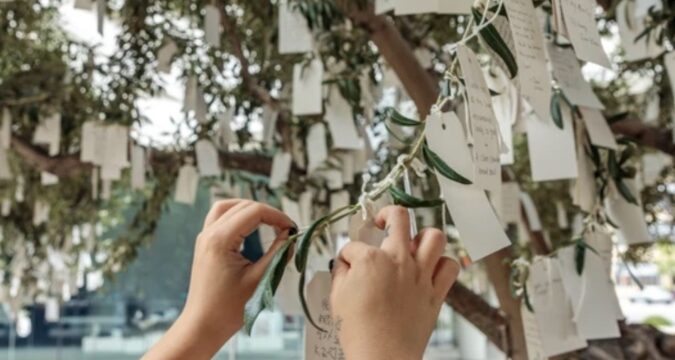
The olive trees outside The Broad have become a place for Angelenos to leave their wishes. As part of Yoko Ono: Music of the Mind, visitors have tied hundreds of written hopes to their branches, adding to a living artwork Bunker Hill had not yet seen before.
The installation, Wish Trees for Los Angeles, reaches back to a work first realized in 1996 at Shoshana Wayne Gallery in Santa Monica. It is one of several participatory pieces in Ono’s first solo museum exhibition in Southern California. Organized by Tate Modern in collaboration with The Broad, the exhibition spans more than seven decades of work by the artist, musician and activist. It remains on view through October 11, 2026.
“For more than seven decades, Yoko Ono has expanded the possibilities of art as a force for connection and change,” said Joanne Heyler, The Broad’s founding director and president. She described Ono’s emphasis on community and activism as especially timely, and imagination as a source of collective strength.
Born in Tokyo in 1933, Ono spent part of her childhood fleeing the horrors of World War II in the Japanese countryside. She has described imagination as a way to sustain hope during that experience. After moving to New York City in 1956, she became part of its experimental art community and played a role in the development of conceptual art and Fluxus, the international avant-garde movement associated with artists and composers including George Maciunas, La Monte Young and John Cage.
Ono’s work has long proposed that art can happen beyond a studio or museum: in a person’s thoughts, actions and relationships. That idea runs through her “instruction” pieces, short texts asking readers to do something or picture doing it. The exhibition includes typescript drafts of Grapefruit, her 1964 book of more than 200 instructions grouped under music, painting, events, poetry and objects. Among them are “Listen to the sound of the Earth turning,” “Fly,” “Put your shadows together until they become one,” and “Draw a map to get lost.” Some remain acts of imagination. Others become physical works when visitors participate, as they do in Painting to Hammer a Nail (1961/1966).
“Her foundational contributions to 1960s conceptualism and her lifelong commitment to participation have redefined what art can be and do,” said Sarah Loyer, The Broad’s curator and exhibitions manager. Loyer said the work Ono has made across the United States, the United Kingdom and Japan shares a sense of empowerment, inviting audiences to help create and imagine change toward peace and equality.
The exhibition also follows Ono’s public campaigns against war. Materials from Acorn Event (1968) document a project made with her late husband, John Lennon. The two planted acorns as a living sculpture for an exhibition at Coventry Cathedral in England, then sent acorns to world leaders to plant as symbols of peace. In Bed Peace (1969), their bed-in events in Amsterdam and Montreal used worldwide media attention to speak against the Vietnam War.
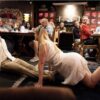
Film and video show another side of Ono’s practice. Footage of Cut Piece, first performed at Yamaichi Hall in Kyoto in 1964, records the audience cutting pieces from her clothing while she sat silently onstage. Also included are FILM NO. 1 (“MATCH”) / Fluxfilm No. 14 (1966), which shows a match being struck in slow motion; FILM NO. 4 (“BOTTOMS”)(1967), once banned by the British Board of Film Censors; and video works made with Lennon.
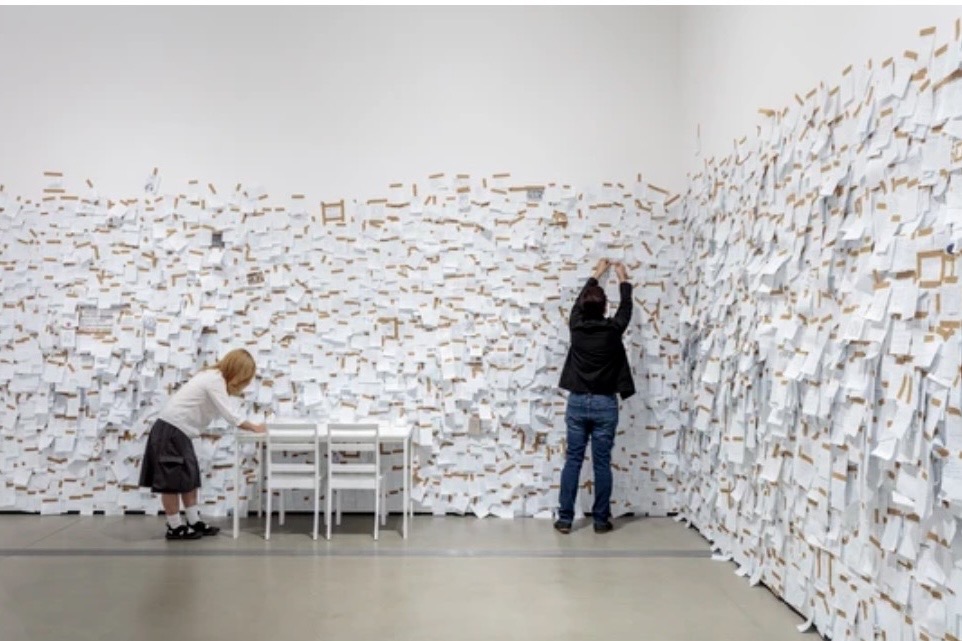
Later installations return to the idea that an individual act can become part of something larger. In Helmets (Pieces of Sky)(2001), visitors may take a puzzle piece from overturned World War II-era German soldier helmets. The pieces suggest a sky that could be assembled into a whole. “Take a piece of sky. Know that we are all part of each other,” Ono instructs. In My Mommy is Beautiful (2004), visitors can write about their mothers or pin up photographs. Their contributions accumulate over the exhibition’s run, forming a record of the many emotions and experiences within those relationships.
Juliet Bingham, curator of international art at Tate Modern, curated Yoko Ono: Music of the Mind. Loyer curated The Broad’s presentation. The museum has also announced performances and other programming connected to the exhibition.
Founded in 2015 by philanthropists Eli and Edythe Broad, The Broad offers free general admission and houses a growing collection of postwar and contemporary art. Its Grand Avenue building was designed by Diller Scofidio + Renfro. The museum is also home to The Broad Art Foundation’s lending library, which has loaned works to museums worldwide since 1984. An expansion is planned to open before the 2028 Los Angeles Olympics.
Yoko Ono: Music of the Mind is on view through October 11, 2026, at The Broad, 221 S. Grand Avenue, Los Angeles. Tickets are available now at thebroad.org. Exhibition admission is $21 for adults, with free admission on Thursdays from 5 to 8 p.m. General museum admission remains free; a general admission ticket alone does not include the special exhibition. Walk-ups are welcome subject to capacity.
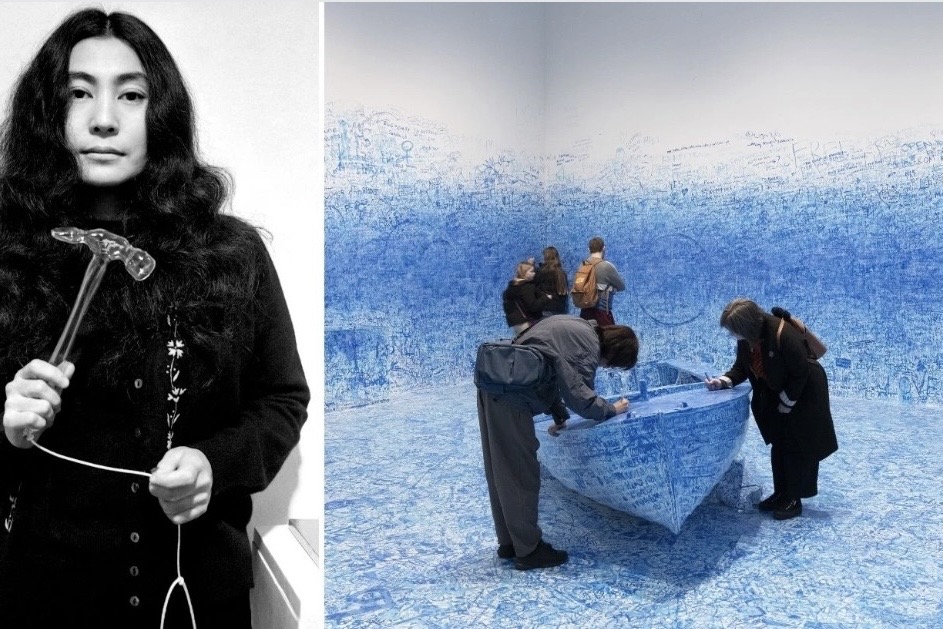
Image credits, if accompanying the article: Yoko Ono holding Glass Hammer at Lisson Gallery, London, 1967: © Yoko Ono; photograph by and © Clay Perry. Visitors at Add Colour (Refugee Boat) at Tate Modern, London, 2024: © Yoko Ono; photograph © Oliver Cowling, courtesy of Tate.